American Eagle Gold Coins represent the official gold bullion coin of the United States, backed by the U.S. government for weight and purity since 1986. These coins serve dual purposes as both investment vehicles and collectible items, making them popular among investors and coin collectors worldwide.
The American Gold Eagle coins are made from 22-karat gold and come in four different sizes ranging from one-tenth ounce to one full ounce. Each coin contains its stated weight in pure gold, with additional silver and copper added for durability. The coins feature iconic American imagery that has evolved over time, including recent design changes that collectors actively seek.
Understanding the technical specifications, investment potential, and authentication methods helps buyers make informed decisions about these government-backed gold coins. The coins offer multiple purchasing options through authorized dealers, with prices that fluctuate based on gold market conditions and coin rarity.
Key Takeaways
- American Eagle Gold Coins are the official U.S. gold bullion coins guaranteed by the government for weight and purity
- The coins come in four sizes with 22-karat gold composition and feature evolving designs since 1986
- Both bullion and collectible versions are available through authorized dealers with prices based on gold content and rarity
Overview of American Eagle Gold Coins
American Eagle Gold Coins are the official gold bullion coins of the United States, first released in 1986 and backed by the U.S. government for weight and purity. These coins come in three distinct versions and hold legal tender status despite containing more gold than their face value indicates.
What Are American Eagle Gold Coins?
American Eagle Gold Coins represent the United States’ flagship gold bullion coin, authorized by the Gold Bullion Coin Act of 1985. The United States Mint produces these coins using gold sourced exclusively from American mines.
The coins feature Augustus Saint-Gaudens’ iconic Lady Liberty design on the front. She holds a torch and olive branch with the U.S. Capitol building in the background. The back shows a family of eagles designed by Miley Busiek.
American Gold Eagle coins are available in four sizes: 1/10 oz, 1/4 oz, 1/2 oz, and 1 oz denominations. Each size contains different amounts of pure gold while maintaining the same design elements.
The U.S. Mint has produced these gold coins continuously since 1986. They have become among the most recognized and trusted gold bullion coins worldwide.
Bullion, Proof, and Burnished Versions
The United States Mint produces American gold eagle coins in three distinct finishes. Each version serves different purposes for investors and collectors.
Bullion coins have a standard finish and are sold primarily for their gold content. These coins trade closest to the current gold spot price. Most investors choose bullion versions for portfolio diversification.
Proof coins feature mirror-like backgrounds with frosted design elements. The U.S. Mint strikes these coins multiple times using specially polished dies. Proof versions come in protective cases and appeal to collectors.
Burnished coins have a matte-like finish created through special processing. The Mint produces fewer burnished coins than bullion versions. These coins fall between bullion and proof in terms of premium pricing.
Legal Tender Status and Purity
American Eagle Gold Coins carry legal tender status in the United States. The coins have face values of $5, $10, $25, and $50 depending on their size. However, their gold content makes them worth significantly more than these denominations.
The gold eagles are minted from 22-karat gold with .9167 fine gold content. The remaining metal consists of silver and copper alloy. This composition makes the coins more durable than pure gold.
Ready to Protect Your Retirement?
Request your free State-Specific Gold IRA information kit and take the first step toward securing your financial future with precious metals.
Free Gold IRA GuideThe U.S. government guarantees the weight, content, and purity of every American gold eagle. This backing provides confidence for investors purchasing these bullion coins. The guarantee distinguishes American Eagles from private mint gold products.
History and Legislation
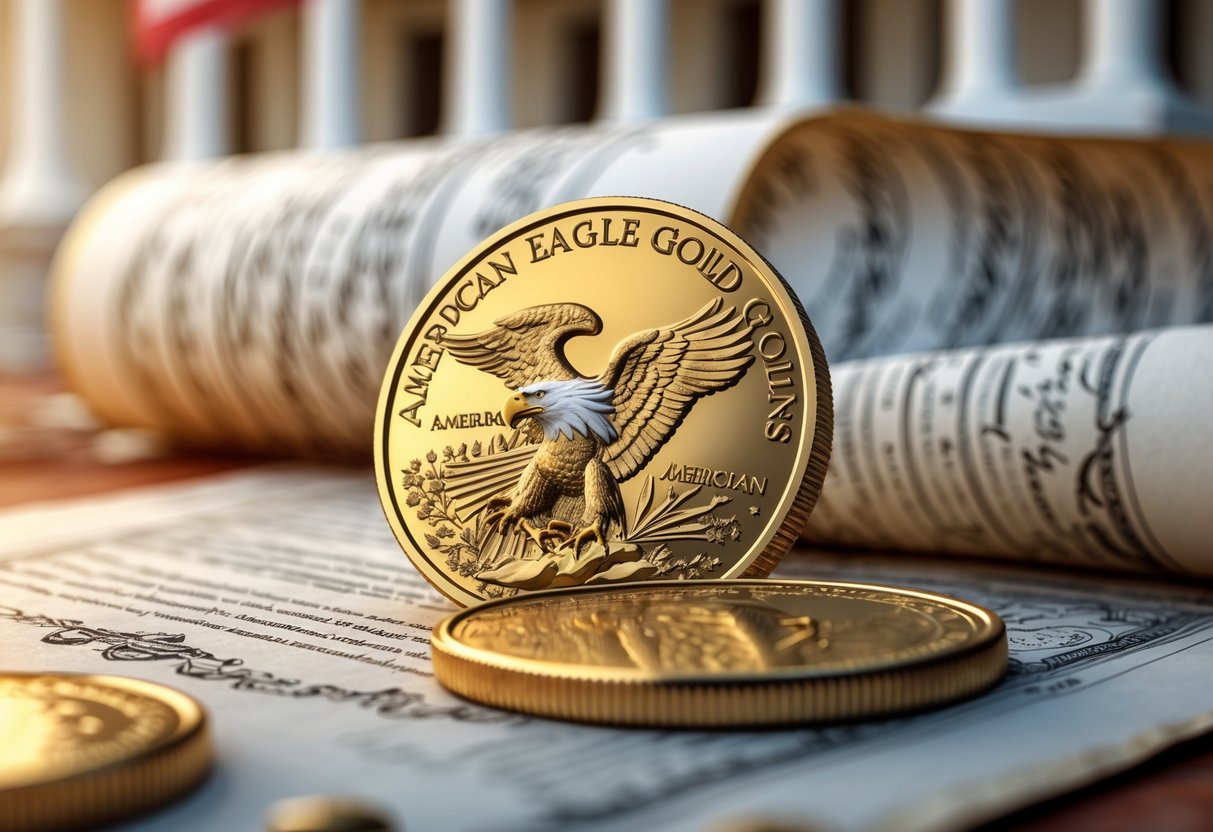
The American Gold Eagle emerged from specific congressional legislation in 1985 and began production in 1986. This program marked the United States’ return to gold coin production after decades of prohibition.
Origins and Authorization
The American Gold Eagle program originated from Congress’s desire to provide Americans with a government-backed gold investment option. For over 50 years, the U.S. government had prohibited private gold ownership and stopped minting gold coins.
The political climate shifted in the 1980s as lawmakers recognized the need for domestic gold bullion products. Foreign gold coins dominated the American market, creating demand for a trusted U.S. alternative.
Congress exercised its constitutional authority to coin money under Article I, Section 8, Clause 5. The Gold Bullion Coin Act was passed by Congress using this exclusive power to create and regulate currency.
The legislation required that gold used in these coins come from newly mined U.S. deposits. This requirement supported domestic mining operations and ensured the coins contained American gold.
Production Timeline
The U.S. Mint first released the American Gold Eagle in 1986, one year after the authorizing legislation passed. Production began at the West Point facility in New York.
Initial production focused on establishing the coin’s reputation in the bullion market. The mint produced coins in four denominations from the start: one ounce, half ounce, quarter ounce, and tenth ounce.
Key Production Milestones:
- 1986: First coins released to the public
- 1987: Proof versions introduced for collectors
- 2006: Burnished uncirculated versions added
- 2021: New reverse design introduced
The program has continued uninterrupted since 1986. Annual production varies based on market demand and economic conditions.
Gold Bullion Coin Act of 1985
The Gold Bullion Coin Act of 1985 established the legal framework for American Gold Eagle production. This landmark legislation authorized the Secretary of the Treasury to issue gold coins in specific denominations.
How Much Will Your Gold IRA Really Cost?
See exactly how much you'll pay in setup, annual, and storage fees. Get personalized company recommendations based on your investment amount and retirement timeline.
Calculate My Total FeesThe act mandated four face values: $50, $25, $10, and $5. These correspond to the four different sizes of gold coins weighing one ounce, half ounce, quarter ounce, and tenth ounce respectively.
Key Requirements:
- Gold content: 91.67% pure gold (22 karat)
- U.S. sourced gold from new mining operations
- Legal tender status with government backing
- Standardized weights and dimensions
The legislation specified that coins must be struck from 22-karat gold alloy. This composition includes small amounts of silver and copper to increase durability while maintaining high gold content.
The act also established quality standards and authorized both bullion and numismatic versions. This dual approach served both investors seeking gold content and collectors wanting premium finishes.
Design Evolution
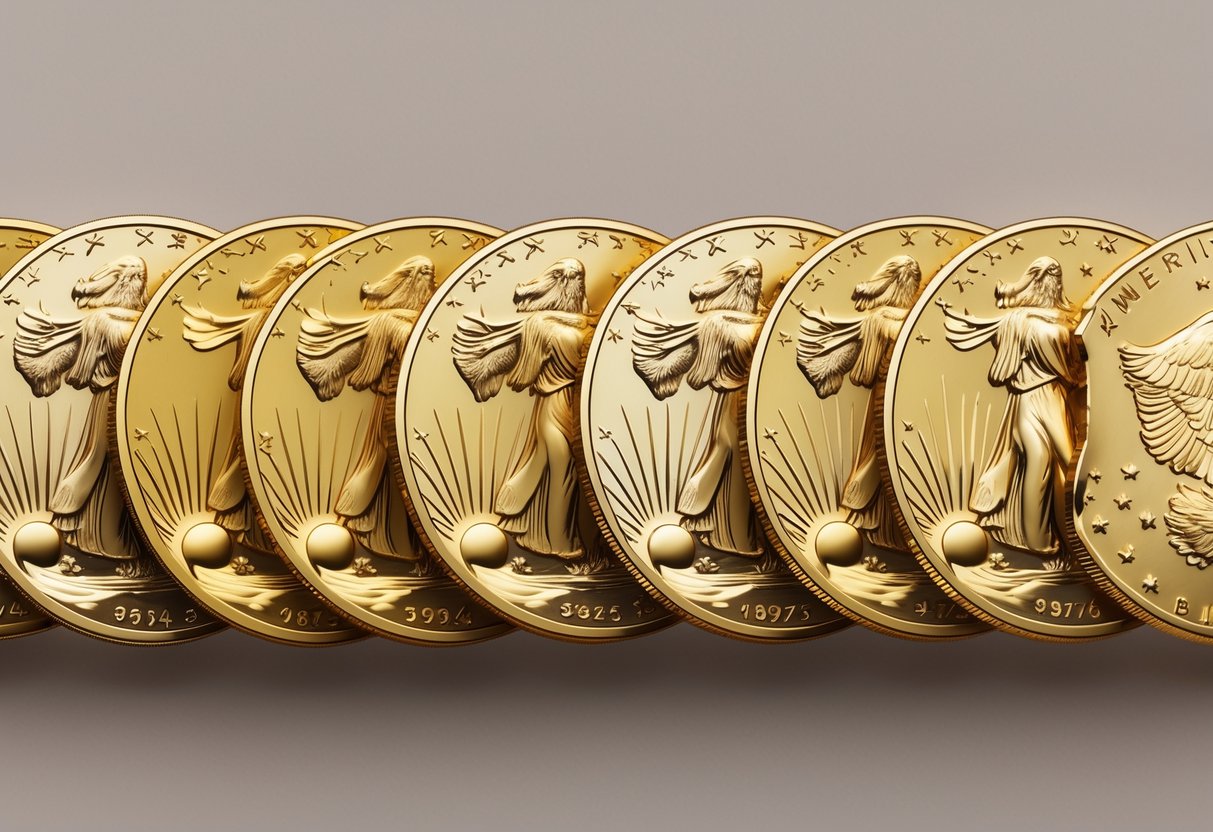
The American Eagle Gold Coin features two distinct design periods that showcase America’s artistic heritage. The original 1986 design drew from classical numismatic art, while a major 2021 update introduced contemporary elements while maintaining the coin’s iconic symbolism.
Obverse: Lady Liberty and Augustus Saint-Gaudens
The obverse design of the American Eagle Gold Coin showcases one of the most celebrated pieces in American numismatic history. Augustus Saint-Gaudens created this masterpiece for the $20 Double Eagle coin between 1907 and 1933.
Lady Liberty dominates the design, striding forward with confidence and purpose. She holds a torch high in her right hand, symbolizing enlightenment and progress. An olive branch rests in her left hand, representing peace.
Her flowing hair and robes capture movement and grace. The Capitol building appears in the background, reinforcing American democratic values. The word “LIBERTY” arches above her head.
Saint-Gaudens’ attention to detail remains evident in every element. The folds of Liberty’s gown, the intricate hair details, and her facial features demonstrate exceptional craftsmanship. This liberty design has remained unchanged since the coin’s 1986 introduction.
Reverse: Bald Eagle Motifs
The reverse side featured a family of eagles design from 1986 to 2020. Miley Busiek created this powerful imagery that emphasized American strength and family values.
The design showed a male bald eagle soaring toward a nest. He carried an olive branch in his talons, representing the nation’s commitment to peace. A female eagle tended to her eaglets in the nest below.
The american bald eagle family symbolized protection, unity, and care. Intricate feather details and nest textures demonstrated exceptional artistry. The inscriptions “UNITED STATES OF AMERICA” and “E PLURIBUS UNUM” surrounded the eagles.
Don't Pay More Taxes Than You Have To
The wrong Gold IRA choice could cost you thousands in unnecessary taxes. See exactly how much you'll pay in taxes with a Traditional vs. Roth Gold IRA. Compare both options side-by-side based on your age, income, and retirement timeline.
This bald eagle design served as a complement to the obverse Lady Liberty. The coin’s weight and face value appeared prominently below the eagle family scene.
2021 Redesign by Jennie Norris
The U.S. Mint introduced a completely new reverse design in 2021 while keeping the Saint-Gaudens obverse intact. Jennie Norris created this updated artwork that modernized the coin’s appearance.
The new design features a single bald eagle in flight, captured in stunning detail. The eagle’s wings are spread wide, showing individual feather definition and natural movement. This simplified approach focuses attention on the bird’s power and majesty.
Enhanced security features accompany the new design. The updated reverse includes anti-counterfeiting elements that protect against fraud. The inscriptions maintain their traditional placement and content.
Jennie Norris brought fresh perspective to the iconic coin series. Her design maintains the patriotic symbolism while offering contemporary artistic interpretation. The 2021 redesign represents a significant milestone in the coin’s 35-year history.
Technical Specifications
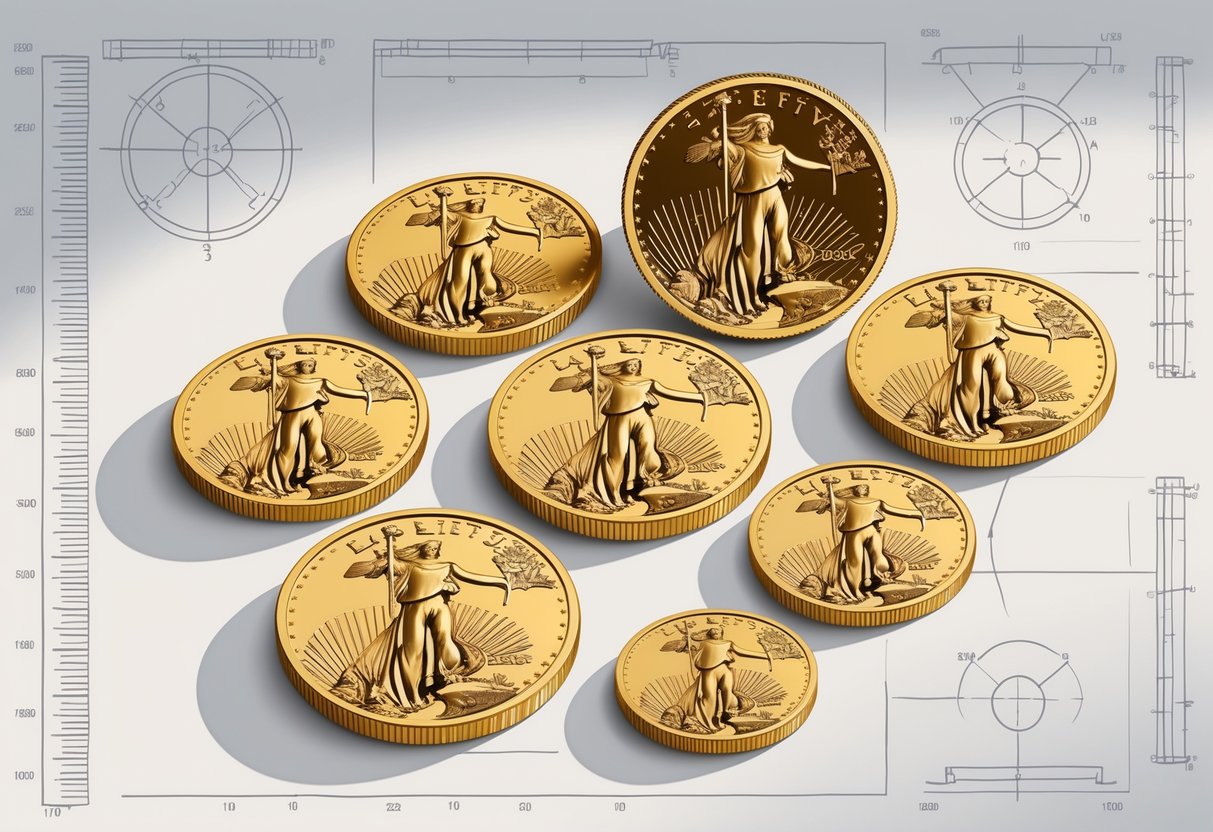
American Gold Eagle coins are manufactured to precise standards that ensure consistent quality and purity. These bullion coins feature specific weights, dimensions, and gold content that meet strict government requirements.
Coin Sizes and Weights
The U.S. Mint produces American Gold Eagle coins in four distinct sizes. Each size corresponds to a specific weight and gold content.
The 1 oz Gold Eagle weighs 1.0909 troy ounces total. This is the most popular size among investors and collectors.
The 1/2 oz Gold Eagle weighs 0.5454 troy ounces total. It contains exactly half the gold content of the full ounce coin.
The 1/4 oz Gold Eagle weighs 0.2727 troy ounces total. This smaller denomination offers an affordable entry point for new precious metals investors.
The 1/10 oz Gold Eagle weighs 0.1091 troy ounces total. It represents the smallest denomination in the series.
Each coin’s total weight exceeds its pure gold content. This difference accounts for the silver and copper alloy added for durability.
Gold Content and Alloy Composition
American Gold Eagle bullion coins contain 22-karat gold. This translates to 91.67% pure gold content by weight.
Gold IRA Company Comparison Checklist
Before choosing a Gold IRA company, use our comprehensive checklist to compare fees, reputation, storage options, and customer service ratings.
Download ChecklistThe remaining 8.33% consists of silver and copper alloy. Silver comprises 3% of the total weight. Copper makes up 5.33% of the total weight.
This alloy composition creates a more durable coin than pure gold. The added metals resist scratching and wear during handling.
Each coin contains its full stated weight of pure gold. A 1 oz Gold Eagle contains exactly one troy ounce of pure gold despite weighing more than one ounce total.
The gold must come from newly mined American sources by law. This requirement supports domestic mining operations.
Face Value and Dimensions
American Gold Eagle coins carry official face values despite trading at much higher market prices. The 1 oz coin has a $50 face value and measures 32.7mm in diameter with a thickness of 2.87mm.
The 1/2 oz coin carries a $25 face value. It measures 27.0mm in diameter with a thickness of 2.24mm.
The 1/4 oz coin has a $10 face value and measures 22.0mm in diameter with a thickness of 1.83mm.
The 1/10 oz coin features a $5 face value. It measures 16.5mm in diameter with a thickness of 1.26mm.
All gold coins feature a reeded edge design. This security feature helps prevent counterfeiting and maintains the coin’s authentic appearance.
The face values represent legal tender status but remain far below the coins’ actual gold content value.
Investment Value and Collectibility
American Gold Eagle coins offer dual appeal as both precious metals investments and collectible items. Their value depends on gold spot price movements, condition, rarity, and market demand, while government backing provides authenticity and global recognition.
Factors Affecting Value
Multiple elements determine an American Gold Eagle’s worth beyond its gold content. The coin’s condition plays a major role, with mint state and proof versions commanding higher premiums than circulated pieces.
Reserved for Portfolios of $500K or More
Your portfolio qualifies you for an exclusive one-on-one web conference with a senior precious metals advisor, priority service, and direct access to strategies reserved for our most valued clients.
Request Your Exclusive GuideRarity significantly impacts collectible value. Low mintage years and special varieties can trade well above their gold content value. First-year 1986 coins and proof versions typically carry higher premiums.
The coin’s finish affects pricing. Bullion versions trade closest to gold spot price, while proof coins with mirror-like surfaces command substantial premiums. Burnished coins with matte finishes fall between these categories.
Key Value Drivers:
- Gold content and current spot price
- Condition and grading
- Mintage numbers and rarity
- Proof vs. bullion finish
- Age and historical significance
Certified coins graded by professional services often bring higher prices due to guaranteed authenticity and condition assessment.
Pricing and Gold Spot Price
American Gold Eagle pricing follows gold spot price movements with added premiums for manufacturing and dealer costs. Bullion versions typically trade at $35-80 over spot per ounce depending on size and market conditions.
One-ounce coins generally offer the lowest premiums per ounce of gold content. Smaller fractional sizes carry higher percentage premiums but provide flexibility for partial sales or gifts.
Premium calculations reveal the markup above gold content value. Investors subtract the coin’s gold value (weight × current spot price) from the total purchase price to determine additional costs.
Premium Ranges by Type:
- Bullion: 3-8% over gold content
- Proof: 15-50% over gold content
- Special varieties: 100%+ over gold content
Market volatility can cause premium spikes during high demand periods or supply shortages.
Liquidity and Market Demand
American Gold Eagle coins provide excellent liquidity due to worldwide recognition and government backing. Bullion versions typically sell back at 95-98% of current retail pricing, making them highly liquid investments.
Dealers, coin shops, and online platforms readily buy and sell these coins. The tight bid-ask spreads on bullion versions make them attractive for investors who may need quick liquidation.
Gold Eagles are easily recognizable and generally sell at higher premiums than bars, making them preferred choices for many precious metals investors.
Market demand remains strong due to their status as America’s official gold bullion coin. International recognition ensures global acceptance and trading opportunities.
Your Complete Gold IRA Beginner's Guide
No confusing jargon. No pressure. Just clear answers about how Gold IRAs work, what they cost, and whether they're right for your retirement. Get the facts before you invest.
Get Your Free Starter GuideIRA Eligibility
American Gold Eagle coins qualify for precious metals Individual Retirement Accounts (IRAs). These coins are IRA-eligible precious metals that can provide tax advantages for long-term investors.
Gold IRAs allow investors to hold physical gold bullion while deferring taxes until withdrawal. This feature makes American Gold Eagles particularly attractive for retirement planning and wealth preservation strategies.
The coins must meet specific storage requirements in IRA accounts. Approved depositories handle storage and insurance, ensuring compliance with IRS regulations.
IRA Benefits:
- Tax-deferred growth potential
- Portfolio diversification
- Inflation hedge within retirement accounts
- Government-backed authenticity
Professional custodians manage the purchase, storage, and sale of Gold Eagles within IRA structures, simplifying the process for investors.
Buying and Authenticity
American Gold Eagle coins require careful purchasing decisions and authentication skills to protect your investment. Working with authorized dealers and understanding key authentication markers helps ensure you receive genuine coins from the United States Mint.
How to Buy American Eagle Gold Coins
The United States Mint does not sell directly to the public. Instead, they distribute through a network of authorized dealers who purchase bulk quantities.
Purchase Options:
- Local coin dealers
- Online precious metals retailers
- Coin shows and exhibitions
- Auction houses (for rare dates)
American Gold Eagle coins come in four sizes: 1 oz, 1/2 oz, 1/4 oz, and 1/10 oz. Each size contains different amounts of gold content measured in troy ounces.
Types Available:
- Bullion coins: Standard investment grade
- Proof coins: Special collector versions with mirror finishes
- Uncirculated coins: Business strike quality
Pricing includes the gold spot price plus a premium. Premiums vary based on coin size, type, and dealer markup. Smaller denominations typically carry higher premiums per ounce.
Choosing Reputable Dealers
Working with reputable coin dealers provides the best protection against counterfeit coins. The U.S. Mint maintains a list of authorized bullion coin dealers on their official website.
Don't Choose Blindly
Selecting the right Gold IRA company is crucial for your retirement. Use our comprehensive comparison checklist to evaluate providers and make the best decision for your financial future.
Get Your ChecklistDealer Verification Steps:
- Check U.S. Mint authorized dealer list
- Verify business licenses and registrations
- Read customer reviews and ratings
- Confirm return policies and guarantees
Established dealers often provide certificates of authenticity and proper packaging. They also offer buyback programs for future sales.
Red Flags to Avoid:
- Prices significantly below market value
- Dealers without physical addresses
- No return policy or guarantees
- Pressure to buy immediately
Professional numismatic organizations like the American Numismatic Association provide dealer directories and consumer protection resources.
Recognizing Authentic Coins
Counterfeit American Eagle gold coins use advanced techniques that make detection challenging. Multiple authentication methods provide better protection than single tests.
Visual Inspection:
- Sharp, detailed design elements on Lady Liberty
- Proper font styles and serifs on lettering
- Correct rim thickness and edge definition
- No “COPY” markings anywhere on the coin
Physical Measurements:
- Weight: 1 oz coin weighs exactly 33.931 grams
- Diameter: 1 oz coin measures 32.7mm
- Thickness: 1 oz coin measures 2.87mm
Authentication Tools:
- Digital scale (accurate to 0.01 grams)
- Calipers for diameter measurements
- Jeweler’s loupe for detail examination
- Magnet test (real gold is not magnetic)
Proof American Eagle coins should arrive in sealed plastic capsules with satin-lined presentation cases. Documentation should include dealer certificates and proper packaging materials.
Professional coin grading services like PCGS or NGC provide third-party authentication for valuable coins. Their sealed holders guarantee authenticity and condition grades.
Frequently Asked Questions
American Eagle Gold Coins involve specific factors that determine their market value, from gold content composition to mintage years. Price fluctuations stem from multiple economic influences, while purchasing options range from authorized dealers to online platforms for various fractional sizes.
What factors influence the value of American Eagle Gold Coins?
The spot price of gold serves as the primary factor determining American Eagle Gold Coin values. This price changes throughout each trading day based on global market conditions.
Coin condition significantly affects value beyond gold content. Well-preserved coins command higher premiums than damaged or worn examples.
How Gold Performed During Every Stock Market Crash
See the data: when stocks dropped 19.4% in 2022, gold only fell 4.3%. Compare gold's downside protection across decades of market volatility and economic crises.
Compare Crash PerformanceMintage year plays a crucial role in pricing. Certain years produced fewer coins, making them more valuable to collectors and investors.
Market demand influences premiums above gold spot price. During times of economic uncertainty, premiums typically increase due to higher buyer interest.
The coin’s denomination affects its premium per ounce. Smaller fractional coins like 1/10 oz typically carry higher premiums than larger 1 oz coins.
How is the composition of American Gold Eagle Coins determined?
American Gold Eagle Coins contain 22-karat gold, which equals 91.67% pure gold content. The U.S. Mint established this composition when the series launched in 1986.
The remaining 8.33% consists of silver and copper alloys. This mixture includes 3% silver and 5.33% copper.
The copper content gives American Eagles their distinctive reddish hue. This differs from 24-karat gold coins that appear more yellow.
The 22-karat composition makes the coins more durable than pure gold. Pure gold is softer and more prone to scratching and denting.
What can cause the price fluctuations of 1 oz American Eagle Gold Coins?
Economic uncertainty drives significant price movements in gold markets. Inflation concerns, currency devaluation, and geopolitical tensions typically increase gold demand.
Interest rate changes affect gold prices inversely. When rates rise, gold becomes less attractive compared to interest-bearing investments.
Global supply and demand dynamics influence pricing. Mining disruptions, central bank purchases, and industrial demand all impact gold values.
Stock market performance often moves opposite to gold prices. During market downturns, investors frequently seek gold as a safe haven asset.
The U.S. dollar strength affects gold pricing since gold trades in dollars globally. A stronger dollar makes gold more expensive for foreign buyers.
Where can investors typically purchase American Eagle Gold Coins?
Authorized precious metals dealers offer the most common purchasing option. These dealers maintain direct relationships with major distributors and provide competitive pricing.
Online bullion dealers provide convenient purchasing with competitive premiums. Many offer secure storage options and buyback programs for customers.
Plan Your Gold IRA Distributions Strategically
Calculate which ounces to sell, when to take distributions, and how to minimize tax impact. Get your personalized RMD strategy based on current gold prices and IRS tables.
Create My RMD PlanLocal coin shops allow buyers to inspect coins before purchase. These shops often provide personalized service and local market knowledge.
Banks occasionally sell American Eagle Gold Coins, though selection may be limited. Some banks require existing customer relationships for precious metals transactions.
The U.S. Mint sells proof and uncirculated versions directly to consumers. These collector versions carry higher premiums than standard bullion coins.
How is the value of an American Eagle Gold Coin assessed based on its year of mintage?
Mintage numbers determine relative scarcity for each year. Lower mintage years typically command higher premiums from collectors and investors.
The 1991 and 1992 American Eagle Gold Coins have lower mintages than most years. These coins often sell for significantly higher premiums above gold spot price.
First-year coins from 1986 carry collector appeal beyond their gold content. The inaugural year status adds numismatic value for many buyers.
Market conditions during specific years affect current values. Years with high demand or unusual circumstances often maintain premium pricing.
Special editions or design changes increase certain years’ values. The 2021 design change created additional collector interest in that year’s coins.
What options are available for those looking to buy fractional American Eagle Gold Coins, such as the 1/10 oz size?
The 1/10 oz American Eagle Gold Coin offers the smallest denomination in the series. This size carries a $5 face value and contains 0.1 troy ounces of gold.
Quarter-ounce and half-ounce options provide middle-ground choices. The 1/4 oz coin has a $10 face value, while the 1/2 oz carries $25 face value.
Fractional coins typically carry higher premiums per ounce than full-ounce coins. The smaller size increases production costs relative to gold content.
Many dealers offer fractional coins in tubes or rolls for bulk purchases. This packaging reduces per-unit costs for buyers seeking multiple coins.
Fractional American Eagles appeal to investors with smaller budgets or those seeking gift options. The lower entry price makes gold ownership more accessible to new investors.




One More Thing...
If you're serious about protecting your retirement, get the complete Gold IRA guide. It's free, there's no obligation, and it could be one of the smartest financial decisions you make.
Get Your Guide