Swiss Gold Francs represent one of Europe’s most respected and historically significant gold coin series, combining Swiss precision with enduring investment value. These elegant coins have served as both legal tender and store of wealth for over a century, making them attractive to collectors and investors worldwide.
The 20 Franc gold coins, particularly the famous Vreneli series minted from 1897 to 1949, contain 0.1867 ounces of pure gold at 90% purity and trade among the least expensive world gold coins relative to their gold content. This combination of affordability, historical significance, and Swiss craftsmanship has made them popular choices for those seeking fractional gold investments with cultural heritage.
Understanding these coins requires exploring their rich symbolism, minting history, and place in both numismatic collecting and precious metals investing. Swiss gold 20 francs are among the least expensive world gold coins, offering investors access to nearly 150 years of Swiss monetary tradition while providing portfolio diversification through physical gold ownership.
Key Takeaways
- Swiss Gold Francs are 90% pure gold coins that offer affordable entry into fractional gold investing with historical significance
- The famous Vreneli series represents Swiss independence and financial stability through distinctive design elements and superior craftsmanship
- These coins provide collectors and investors with liquid, recognizable gold assets backed by Switzerland’s reputation for monetary excellence
What Are Swiss Gold Francs?

Swiss Gold Francs are gold coins issued by Switzerland that served as legal tender and now function primarily as investment products. These coins contain actual gold content and carry both historical significance and precious metal value.
Definition and Overview
Swiss Gold Francs are gold coins minted by the Swiss Confederation in denominations of 10, 20, and 100 francs. The most common and recognizable is the 20-franc piece, known as the Goldvreneli or Helvetia.
These coins contain 90% gold and 10% copper alloy. The 20-franc coin contains 5.807 grams of fine gold and weighs 6.452 grams total.
Switzerland produced these coins as part of its monetary system. The country was a member of the Latin Monetary Union from 1865, which standardized gold coin specifications across participating European nations.
Key Specifications:
- Fineness: 900/1000 gold
- Diameter: 21.00mm (20-franc)
- Fine gold weight: 0.1867 troy ounces (20-franc)
Legal Tender Status
Swiss Gold Francs maintained legal tender status until 1936 when Switzerland devalued its currency by 30%. This devaluation caused the coins’ gold value to exceed their face value, removing them from circulation.
Before 1936, these coins circulated as regular currency alongside paper money. Citizens used them for everyday transactions and official payments.
After the devaluation, the 20-franc coin’s value rose to 28 francs due to its gold content. This made the coins more valuable as precious metal than as currency.
Today, these coins retain legal tender status but trade based on their gold content rather than face value. The face value of 20 Swiss Francs represents Switzerland’s guarantee of gold purity.
Ready to Protect Your Retirement?
Request your free State-Specific Gold IRA information kit and take the first step toward securing your financial future with precious metals.
Free Gold IRA GuideNotable Series and Variants
The primary series include the Helvetia coins (1883-1896) and the Vreneli coins (1897-1949). The Helvetia series preceded the more famous Vreneli design.
Vreneli Series Production:
- 20-franc coins: 1897-1935, 1947, 1949
- Total minted: Over 58 million coins
- Peak production: 1945-1949 (40 million coins)
The Vreneli features a female head representing Helvetia looking left with braided hair and Swiss Alps in the background. The reverse shows the Swiss cross on an ornate shield with oak branches.
Fritz Landry designed the Vreneli in 1895 after winning a competition for a new coin design. The name “Vreneli” comes from the Swiss German diminutive form of Verena, though this nickname never appeared on the actual coins.
Switzerland also minted 10-franc and 100-franc gold coins with similar designs but different specifications and lower production numbers.
Design and Symbolism
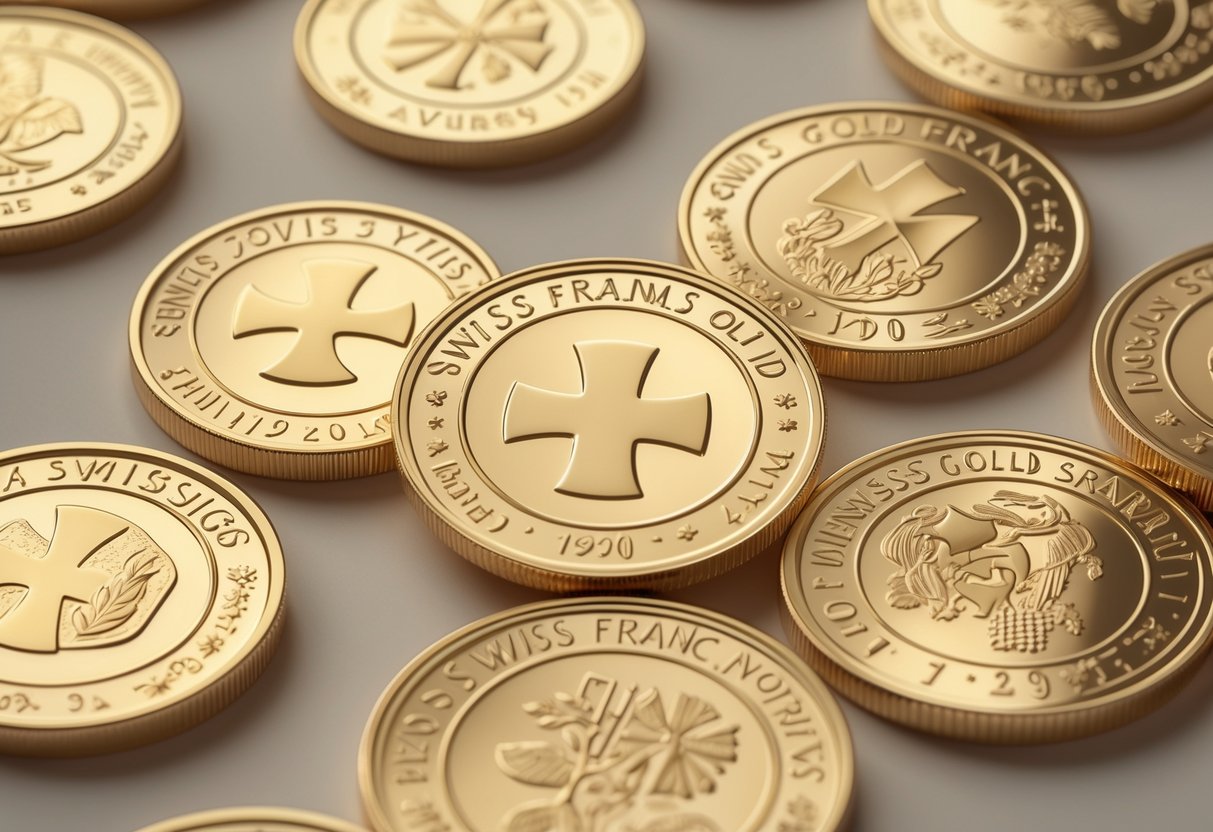
The Swiss Gold Franc features three distinct design elements that represent Swiss national identity and heritage. The obverse displays Helvetia against the Swiss Alps, while the reverse showcases the Swiss shield and cross surrounded by decorative oak branches.
Obverse: Helvetia and the Swiss Alps
The obverse of the Swiss 20 Franc gold coin displays a young female figure representing Helvetia, the national symbol of Switzerland. This feminine personification appears as a youthful woman with braided hair adorned with an alpine flower wreath.
Helvetia wears a dress decorated with edelweiss flowers around the collar. Her hair is styled in a distinctive braid that hangs over her shoulder. The figure faces left in profile, creating an elegant and dignified appearance.
The Swiss Alps form a dramatic backdrop behind Helvetia’s portrait. Mountain peaks stretch across the horizon, emphasizing Switzerland’s alpine geography. The word “HELVETIA” appears in capital letters above the figure’s head.
The artist’s signature “F. LANDRY” appears at the lower right edge of the coin. This refers to Fritz Ulisse Landry, the Neuchâtel medalist who designed the Helvetia motif in 1895.
Reverse: Swiss Shield and Cross
The reverse side features the Swiss coat of arms as the central design element. A prominent Swiss cross sits at the center, displayed on a traditional heraldic shield. The cross uses the classic white cross on red field design.
How Much Will Your Gold IRA Really Cost?
See exactly how much you'll pay in setup, annual, and storage fees. Get personalized company recommendations based on your investment amount and retirement timeline.
Calculate My Total FeesThe Swiss shield is surrounded by decorative elements that frame the national symbol. The denomination “20 FR” appears on the left and right sides of the shield. The year of minting is displayed at the bottom of the coin.
A mint mark “B” typically appears below the year designation. This indicates the coin was struck at the Swiss federal mint. The entire design is encircled by a decorative border that complements the overall composition.
Design Elements: Oak Branch and Wreath
Oak branches form an elaborate wreath that surrounds the Swiss cross and shield. The branches feature detailed leaves and acorns that demonstrate the coin’s high level of craftsmanship. Flowing ribbon ends add movement to the static heraldic elements.
The oak wreath symbolizes strength, endurance, and nobility in Swiss culture. These branches create a natural frame around the national symbols. The detailed botanical elements showcase Swiss attention to precision and artistry.
A pearl border encircles the entire design on both sides of the coin. This decorative element adds elegance and helps define the coin’s edge. The ribbed edge on some denominations features 22 stars representing the Swiss cantons.
The Swiss 20 Franc Vreneli Gold Coin
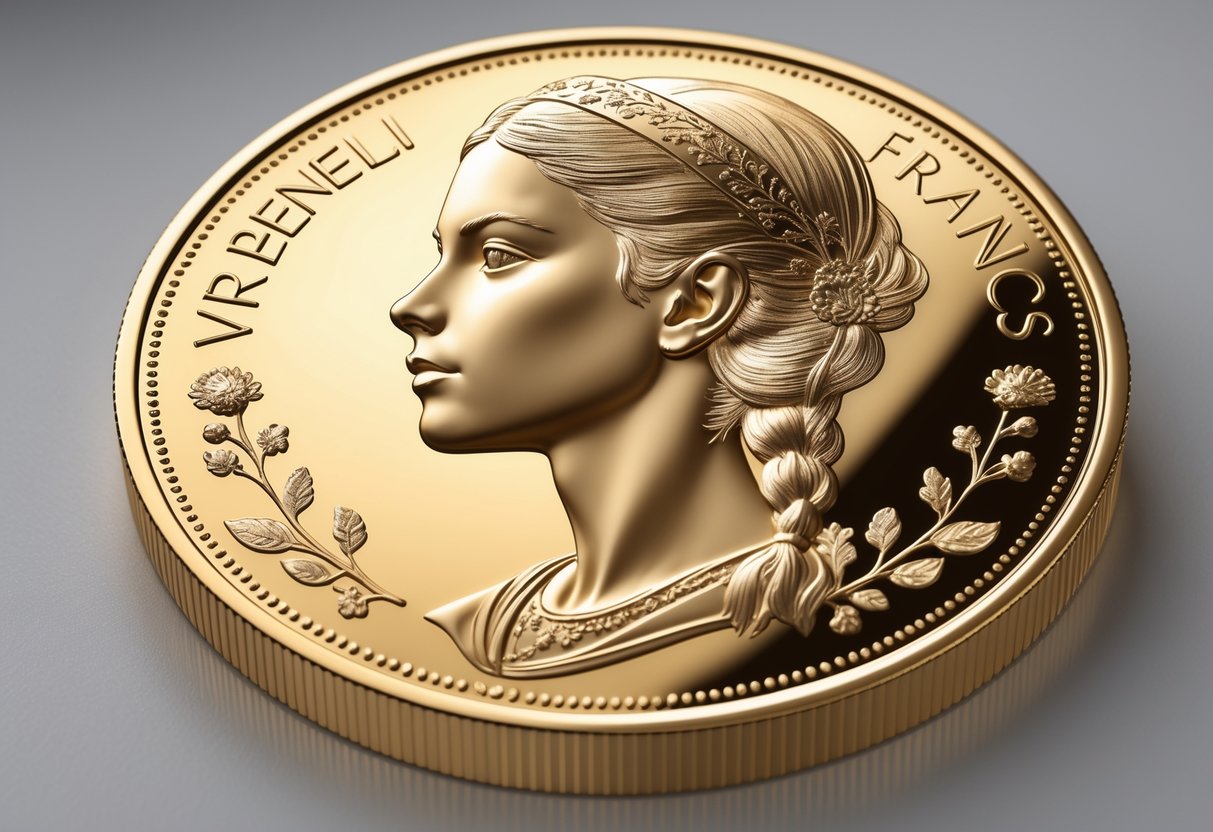
The 20 franc Vreneli represents Switzerland’s most famous gold coin, minted from 1897 to 1949 with over 58 million pieces produced. This coin ceased being legal tender in 1936 when its gold value exceeded its face value due to currency devaluation.
History and Production
The Swiss 20 franc Vreneli gold coin originated in 1895 when the Federal Council announced a redesign competition for the existing 20-franc gold piece. The competition required allegorical depictions or national motifs from Swiss history to create a modern version of Helvetia.
Swiss medallist Fritz Ulisse Landry won the competition with his youthful, romantic depiction of Helvetia. However, the jury requested modifications to make the female figure appear more mature and add a braided wreath to restrain her loose hairstyle.
The original engraved dies were created by Parisian medallist Ernest Paulin Tasset. Critics complained about indistinct contours in the final coins, which made the Helvetia figure appear somewhat plump due to problems in the reduction phase.
Production began in spring 1895, with the first coins appearing that year. The Swiss Mint at Bern produced these coins as part of Switzerland’s membership in the Latin Monetary Union, which standardized gold coin specifications across member countries.
Specifications and Purity
The 20 franc Vreneli weighs 6.452 grams total with a composition of 90% gold and 10% copper. This equals 5.807 grams of pure gold content, or approximately 0.187 ounces.
Don't Pay More Taxes Than You Have To
The wrong Gold IRA choice could cost you thousands in unnecessary taxes. See exactly how much you'll pay in taxes with a Traditional vs. Roth Gold IRA. Compare both options side-by-side based on your age, income, and retirement timeline.
Physical Specifications:
- Diameter: 21.00mm
- Thickness: 1.25mm
- Total Weight: 6.452g
- Gold Content: 5.807g (0.187 oz)
- Purity: 900/1000 (90% gold)
The copper alloy provides durability while maintaining the coin’s gold investment value. These specifications met Latin Monetary Union standards, ensuring compatibility with other European gold coins of the era.
The coin features 22 stars on its edge, representing the Swiss cantons. The obverse displays the Swiss cross surrounded by oak branches, while the reverse shows Helvetia’s profile with mountain backgrounds.
Years of Issue and Mint Marks
The 20 franc coins were produced from 1897 to 1949 with interruptions during certain periods. Regular production occurred from 1897-1936, followed by special issues in 1947 and 1949.
Production Periods:
- 1897-1936: Regular legal tender coins
- 1947: Restrike production
- 1949: Final restrike production
Legal tender status ceased on September 29, 1936 when Switzerland devalued the franc by 30%. The coin’s gold value then exceeded its face value, removing it from circulation.
Original coins carry a “B” mint mark (without a dot) indicating production at the Bern mint. Restrikes produced after 1936 bear an “L” mint mark, distinguishing them from original legal tender pieces.
Between 1945 and 1949, nearly 40 million additional pieces were minted to reduce gold stocks and meet collector demand.
Nickname Origins
The term “Vreneli” never appears on the actual coins, which are officially designated as “Helvetia head” coins. In Swiss German, “Vreneli” represents the affectionate diminutive form of the female name Verena.
The nickname first appeared in print in 1943, reflecting public perception that the youthful Helvetia depiction seemed frivolous. Many Swiss citizens felt the figure resembled a young girl rather than a dignified state symbol.
Gold IRA Company Comparison Checklist
Before choosing a Gold IRA company, use our comprehensive checklist to compare fees, reputation, storage options, and customer service ratings.
Download ChecklistThis informal naming demonstrates how the coin became embedded in Swiss culture beyond its monetary function. Swiss families traditionally give Vreneli coins as gifts for births, baptisms, and special occasions, creating the concept of “Notbatzen” or emergency savings.
The Vreneli should not be confused with the earlier Libertas gold coin, known as the Helvetia, which was minted from 1883 to 1896 as the Vreneli’s direct predecessor.
Collecting and Investing in Swiss Gold Francs

Swiss gold francs offer both investment potential and collectible appeal through their historical significance and precious metal content. These coins command strong market values due to their quality craftsmanship and limited availability.
Market Value and Liquidity
Swiss gold francs maintain strong liquidity in global precious metals markets. The 20 franc denomination remains the most traded due to its abundant mintage of 58.6 million pieces.
Market prices fluctuate based on gold spot prices plus premiums. Premium rates typically range from 3-8% above gold content value. Higher premiums apply to scarcer dates and better conditions.
Key Market Factors:
- Gold content drives base value
- Rarity affects premium pricing
- Dealer networks ensure liquidity
- International recognition supports trading
Vreneli coins trade actively in European markets. Their 90% gold composition makes pricing calculations straightforward for dealers and investors.
Investor and Collector Appeal
Swiss gold coins attract both collectors and investors due to their dual appeal. The swiss mint produced these coins with exceptional quality standards that enhance their desirability.
Collectors value the historical significance and artistic designs. The Helvetia imagery represents Swiss cultural heritage and craftsmanship traditions.
Investors appreciate the tangible asset benefits:
- Hedge against inflation
- Portfolio diversification
- Compact wealth storage
- No counterparty risk
The Vreneli series spans multiple decades from 1897-1949. This extended production period offers collectors numerous date varieties to pursue.
Grading and Condition
Professional grading significantly impacts swiss francs values. Coins receive grades from Poor-1 to Mint State-70 on the Sheldon scale.
Reserved for Portfolios of $500K or More
Your portfolio qualifies you for an exclusive one-on-one web conference with a senior precious metals advisor, priority service, and direct access to strategies reserved for our most valued clients.
Request Your Exclusive GuideCommon grade categories include:
- Very Fine (VF-20 to VF-35) – Moderate wear, details clear
- Extremely Fine (XF-40 to XF-45) – Light wear, sharp details
- About Uncirculated (AU-50 to AU-58) – Slight wear on high points
- Mint State (MS-60 to MS-70) – No circulation wear
Grading services like PCGS and NGC authenticate and grade swiss gold francs. Certified coins typically command higher prices than raw examples.
Surface quality affects values within grade levels. Coins with better eye appeal sell for premiums over typical examples.
Authentication and Storage
Authentication protects against counterfeits in the swiss francs market. Reputable dealers provide guarantees and certificates of authenticity.
Weight and dimensions offer initial verification methods. Genuine 20 franc coins weigh 6.45 grams with 90% gold content.
Storage Requirements:
- Non-reactive plastic holders
- Stable temperature and humidity
- Protective cases or albums
- Secure safe or deposit box
Proper handling prevents damage to coin surfaces. Collectors should hold coins by edges and avoid direct skin contact.
Climate control prevents tarnishing and corrosion. Humidity levels should remain between 30-50% for optimal preservation.
How to Buy and Sell Swiss Gold Francs
Swiss gold francs can be purchased from multiple trusted dealers, and successful transactions require understanding market pricing and secure selling methods. The 20 franc Vreneli remains the most popular option for investors seeking fractional gold coins.
Where to Buy Swiss Gold Francs
Established precious metals dealers offer the widest selection of Swiss 20 franc gold coins with competitive pricing. Major online bullion dealers like APMEX, Money Metals Exchange, and local coin shops maintain regular inventory.
Coin shows and numismatic events provide opportunities to examine coins before purchase. These venues often feature multiple dealers competing for business.
Your Complete Gold IRA Beginner's Guide
No confusing jargon. No pressure. Just clear answers about how Gold IRAs work, what they cost, and whether they're right for your retirement. Get the facts before you invest.
Get Your Free Starter GuideAuthorized dealer benefits:
- Guaranteed authenticity
- Return policies
- Competitive premiums
- Professional grading services
Swiss banks also sell gold coins directly to customers. However, their premiums tend to be higher than specialized bullion dealers.
Online marketplaces require extra caution due to counterfeit risks. Buyers should verify seller credentials and return policies before making purchases.
Secure Selling Practices
Reputable dealers who buy Swiss franc gold coins provide transparent pricing based on current gold spot prices. They typically offer immediate payment and handle authentication testing.
Local coin shops offer face-to-face transactions but may have limited buying capacity. Their buy prices often reflect local market conditions and inventory needs.
Selling preparation steps:
- Research current gold prices
- Get multiple quotes
- Verify coin authenticity
- Document transaction details
Private sales through classified ads or online platforms can yield higher prices. However, they require careful verification of buyer credentials and secure payment methods.
Professional coin grading services add value to rare date Swiss francs. Certified coins command premium prices from collectors and investors.
Pricing and Premiums
The Swiss 20 franc Helvetia gold coin typically carries premiums of 3-8% over gold spot price. Common dates have lower premiums than scarce years like the 1935L restrike.
Premium factors include:
- Coin condition
- Mintage year
- Market demand
- Dealer inventory levels
Bulk purchases often reduce per-coin premiums. Dealers may offer quantity discounts for orders of 20 or more coins.
Don't Choose Blindly
Selecting the right Gold IRA company is crucial for your retirement. Use our comprehensive comparison checklist to evaluate providers and make the best decision for your financial future.
Get Your ChecklistCurrent market considerations:
- Gold spot price fluctuations
- Currency exchange rates
- Economic uncertainty levels
- Collector demand trends
Timing affects both buying and selling prices. Gold prices move throughout each trading day based on global market conditions.
Authentication costs should be factored into selling decisions. Professional testing services charge fees but provide buyer confidence for higher-value transactions.
Cultural and Historical Significance
Swiss gold francs represent more than currency – they embody Switzerland’s national identity through the iconic Helvetia figure and connect the nation to Europe’s monetary history. The Vreneli gold coin became a cultural symbol that Swiss families pass down through generations as treasured heirlooms.
Switzerland’s Gold Legacy
Switzerland established its unified currency system in 1850 after adopting a new federal constitution in 1848. This political shift replaced various cantonal currencies with the Swiss Franc as the official national currency.
The 20 Francs gold coin debuted in 1897 to meet growing demand for Swiss gold currency that could compete internationally. Production continued until 1949, creating a 52-year legacy of consistent minting.
Key Production Timeline:
- 1897: First minting began
- 1911-1916: Peak production years
- 1935-1947: Restrike productions
- 1949: Final official mintage
The coins were minted at multiple Swiss facilities including Bern, Geneva, and Basel. Each mint maintained strict quality control to ensure uniformity in weight, purity, and design across all production locations.
Role in European Coinage
The Swiss 20 Franc gold coin emerged as Switzerland’s answer to dominant European gold currencies. It competed directly with the French Napoleon and British Sovereign in international trade markets.
The coin’s .900 fineness and 5.81 grams of pure gold content established it as a reliable store of value. This consistency made it attractive to merchants and banks throughout Europe for cross-border transactions.
Comparison with European Gold Coins:
- Swiss 20 Francs: 6.45g total weight, .900 fine
- French 20 Francs: 6.45g total weight, .900 fine
- British Sovereign: 7.98g total weight, .917 fine
The Latin inscription “Confoederatio Helvetica” reflected Switzerland’s multilingual heritage. This choice positioned the coin as a neutral, unified currency suitable for international commerce across language barriers.
How Gold Performed During Every Stock Market Crash
See the data: when stocks dropped 19.4% in 2022, gold only fell 4.3%. Compare gold's downside protection across decades of market volatility and economic crises.
Compare Crash PerformanceSymbolism in Swiss Identity
The Vreneli portrait depicts Helvetia as a young Swiss woman with braided hair adorned with edelweiss flowers. This design symbolizes Swiss beauty, purity, and connection to the Swiss Alps.
Fritz Ulysse Landry created the iconic portrait that became synonymous with Swiss numismatics. The figure gazes leftward, representing Switzerland’s forward-looking vision and progressive values.
The reverse features the Swiss coat of arms surrounded by oak leaves. The Swiss cross within the shield represents independence and neutrality, while oak leaves symbolize strength and endurance.
Design Elements:
- Obverse: Helvetia portrait with alpine flowers
- Reverse: Swiss shield with cross and oak leaves
- Inscription: “HELVETIA” and “CONFOEDERATIO HELVETICA”
Swiss people consider the Vreneli a lucky charm and family heirloom. Many Swiss families pass these coins through generations, creating personal connections to their national history and cultural identity.
Frequently Asked Questions
Swiss gold francs contain specific gold content measurements and feature unique design elements that distinguish different years and denominations. The coins carry historical significance from Switzerland’s monetary system and vary in weight depending on their size and era of production.
What are the distinguishing features of the Helvetia gold coin from 1935?
The 1935 Helvetia gold coin represents a low mintage year, making it particularly rare among collectors. This specific year falls within the production period when Switzerland minted these coins with consistent design elements.
The coin features Helvetia on the obverse side with her characteristic profile and diadem. The reverse displays the Swiss coat of arms surrounded by oak leaves, maintaining the standard design used throughout the series.
The 1935 version contains the same specifications as other years in the series. It weighs 6.45 grams total with 90% gold purity and measures 21 millimeters in diameter.
How much gold content is in a 20 franc gold coin?
The 20 franc gold coin contains 5.8 grams of pure gold. This represents the actual gold content within the coin’s total weight.
The coin has a fineness of .900, meaning it contains 90% gold. The remaining 10% consists of copper, which adds durability to the coin structure.
The total weight of the coin reaches 6.45 grams. This includes both the gold content and the copper alloy used in production.
Plan Your Gold IRA Distributions Strategically
Calculate which ounces to sell, when to take distributions, and how to minimize tax impact. Get your personalized RMD strategy based on current gold prices and IRS tables.
Create My RMD PlanWhat is the current value of a Swiss 20 franc gold coin?
The value of a Swiss 20 franc gold coin depends on the current gold spot price multiplied by its gold content. The intrinsic value equals approximately 5.81 grams of pure gold times the current gold price per gram.
Market factors influence the final price beyond just gold content. Rarity, condition, and collector demand can add premiums above the base gold value.
Coins from certain years or in exceptional condition command higher prices. Professional grading and authentication also affect the coin’s market value.
Can you compare the weights of various Helvetia gold coins?
The 20 franc Helvetia gold coin weighs 6.45 grams total. This represents the standard weight for this denomination throughout its production period.
Different denominations of Swiss gold coins have varying weights. Each denomination follows specific weight standards established during the Latin Monetary Union period.
The weight specifications remained consistent across production years. This uniformity helped facilitate international trade and maintained the coin’s credibility in global markets.
What are the historical significances of Swiss gold franc coins?
Swiss gold franc coins emerged when Switzerland adopted the Swiss Franc in 1850 and aligned with Latin Monetary Union standards. This standardization facilitated international trade across European nations.
The coins feature “Confoederatio Helvetica,” the Latin name for the Swiss Confederation. This choice emphasized Switzerland’s neutrality and avoided favoring any of its four national languages.
Production continued from 1897 to 1949, spanning two world wars and significant economic changes. The coins served as a testament to Switzerland’s stable monetary policy during turbulent periods.
How does the 1 oz Swiss gold coin differ from the 10 gm version?
The 1 oz Swiss gold coin contains approximately 31.1 grams of gold, significantly more than smaller denominations. This represents a modern bullion product rather than historical currency coins.
The 10 gram version contains exactly 10 grams of gold content. These coins serve primarily as investment vehicles rather than historical collectibles.
Historical Swiss gold francs like the 20 franc coin contain much less gold than either option. The traditional coins focus on numismatic value combined with gold content rather than pure bullion weight.




One More Thing...
If you're serious about protecting your retirement, get the complete Gold IRA guide. It's free, there's no obligation, and it could be one of the smartest financial decisions you make.
Get Your Guide