Shopping for jewelry can be confusing when you hear about 14-karat gold rings and 2-carat diamonds. These terms sound almost identical but measure completely different things.
Karat measures gold purity while carat measures gemstone weight.
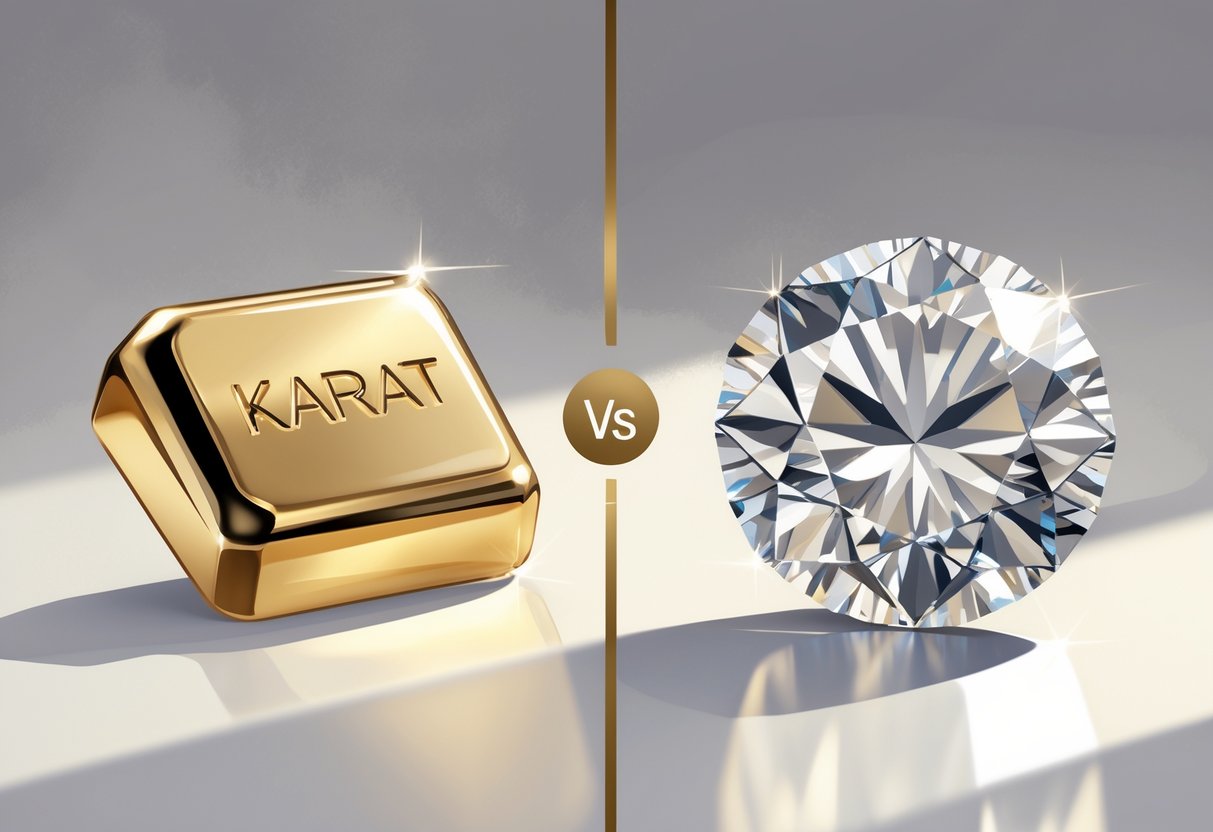
Understanding this difference helps buyers make smarter choices and avoid costly mistakes. A karat indicates the proportion of gold in an alloy out of 24 parts, while a carat weighs exactly 200 milligrams for diamonds and other gems.
Many people mix up these terms, which can lead to confusion when comparing jewelry pieces.
This guide explains how each measurement works, where the words came from, and how they affect jewelry prices. You’ll learn practical tips for shopping and get answers to common questions about gold purity and gemstone weights.
Key Takeaways
- Karat measures gold purity on a scale of 1 to 24, with 24-karat being pure gold
- Carat measures gemstone weight, with one carat equal to 200 milligrams
- Both measurements significantly impact jewelry value and pricing
Karat vs. Carat: Key Differences
The fundamental difference between karat and carat lies in their measurement systems: karat measures gold purity on a 24-part scale, while carat measures gemstone weight in increments of 200 milligrams.
These distinct applications create specific terminology rules within the jewelry industry.
Definitions and Modern Usage
Karat measures the purity of gold alloys using a 24-part scale. Each karat represents 1/24 of the total composition, or approximately 4.17% pure gold content.
Common karat gold varieties include:
- 24K: 100% pure gold (too soft for most jewelry)
- 18K: 75% pure gold (18 parts gold, 6 parts other metals)
- 14K: 58.3% pure gold (14 parts gold, 10 parts other metals)
- 10K: 41.7% pure gold (10 parts gold, 14 parts other metals)
Carat measures the weight of precious stones and diamonds. One carat equals exactly 200 milligrams or 0.2 grams.
For stones under one carat, jewelers use a point system. Each carat divides into 100 points, so a 0.75-carat diamond equals 75 points.
The weight measurement applies to all gemstones, not just diamonds. Ruby, sapphire, and emerald weights all use carat measurements.
Common Confusions in Terminology
The phrase “24-karat diamond” represents a common mistake. Diamonds cannot have karat ratings because karat only applies to gold purity measurements.
Ready to Protect Your Retirement?
Request your free State-Specific Gold IRA information kit and take the first step toward securing your financial future with precious metals.
Free Gold IRA GuideRegional differences add complexity to terminology. In the United States, “karat” specifically describes gold purity while “carat” measures gemstone weight.
However, some countries use different conventions. Australia and the United Kingdom sometimes use “carat” for both gold purity and gemstone weight, creating international confusion.
Key spelling differences:
- Karat (K or kt): Gold purity only
- Carat (ct): Gemstone weight only
Context determines meaning in countries with overlapping usage. A “14-carat gold ring” refers to gold purity, while a “2-carat diamond” always refers to weight.
Applications in Jewelry Industry
Karat gold applications focus on durability and price points. Higher karat numbers indicate more pure gold content but create softer metals.
Jewelry professionals consider:
- 24K gold: Investment pieces, not daily wear
- 18K gold: High-end jewelry with good durability
- 14K gold: Standard engagement rings and wedding bands
- 10K gold: Budget-friendly everyday jewelry
Carat weight significantly impacts precious stones pricing. Diamond prices increase exponentially rather than linearly with carat weight.
Professional considerations include:
- Cut quality affects visual size regardless of carat weight
- Two diamonds with identical carat weights can appear different sizes
- Certification documents specify exact carat weights to three decimal places
The jewelry industry uses both measurements simultaneously. A typical engagement ring might feature “a 1-carat diamond set in 18K gold,” combining both measurement systems in one piece.
What Is “Karat” in Gold?
Karat measures the purity of gold in jewelry and other gold items. The karat system uses a 24-part scale where each karat represents approximately 4.17% pure gold content.
Gold Purity Measurement Explained
The karat system divides gold alloys into 24 equal parts. Each karat represents one part of pure gold mixed with other metals.
How Much Will Your Gold IRA Really Cost?
See exactly how much you'll pay in setup, annual, and storage fees. Get personalized company recommendations based on your investment amount and retirement timeline.
Calculate My Total FeesKarat measures gold purity by showing how much actual gold exists in the final product. For example, 18-karat gold contains 18 parts pure gold and 6 parts other metals.
Jewelers mix pure gold with metals like copper, silver, or zinc. This creates stronger, more durable pieces that resist scratching and bending.
The mathematical formula is simple: karat value ÷ 24 = percentage of pure gold. An 18-karat piece contains 75% pure gold (18 ÷ 24 = 0.75).
What Is Pure Gold and 24-Karat Gold?
Pure gold equals 24-karat gold and contains 99.9% gold content. This represents the highest purity level available in commercial gold products.
24-karat gold appears bright yellow and feels extremely soft. Jewelers rarely use it for everyday jewelry because it scratches easily and bends under pressure.
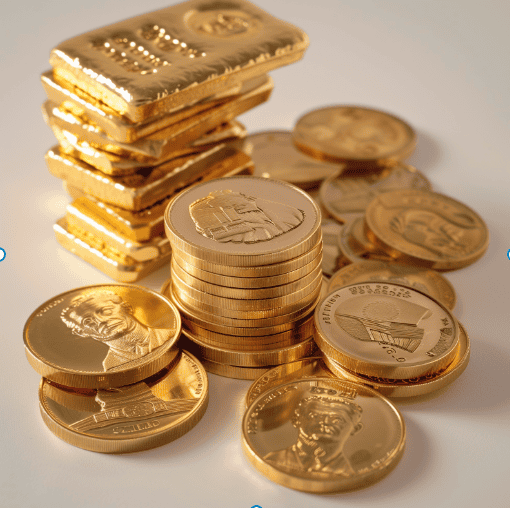
Most 24-karat gold goes into coins, bars, and investment products. Some cultures prefer 24-karat gold for wedding jewelry despite its softness.
The remaining 0.1% consists of trace elements that occur naturally in gold mining. True 100% pure gold exists only in laboratory settings.
Popular Karat Values: 14-Karat and 18-Karat Gold
14-karat gold contains 58.3% pure gold mixed with 41.7% other metals. This creates durable jewelry perfect for daily wear.
18-karat gold contains 75% pure gold and 25% other metals. It offers better color and value than 14-karat while maintaining good durability.
| Karat Value | Gold Percentage | Common Uses |
|---|---|---|
| 14K | 58.3% | Engagement rings, everyday jewelry |
| 18K | 75% | Fine jewelry, luxury pieces |
| 22K | 91.7% | Traditional jewelry, some coins |
14-karat gold costs less than 18-karat gold but provides superior strength. 18-karat gold displays richer color and higher value.
Both options resist tarnishing and maintain their appearance over time. The choice depends on budget, durability needs, and color preferences.
Don't Pay More Taxes Than You Have To
The wrong Gold IRA choice could cost you thousands in unnecessary taxes. See exactly how much you'll pay in taxes with a Traditional vs. Roth Gold IRA. Compare both options side-by-side based on your age, income, and retirement timeline.
Karat Markings and Gold Legitimacy
Legitimate gold jewelry displays karat markings stamped directly into the metal. Karat abbreviations include K or kt followed by the number.
Common markings include 14K, 18K, or 24K. Some pieces show decimal equivalents like 0.585 for 14-karat or 0.750 for 18-karat.
These stamps usually appear in inconspicuous locations like the inside of rings or clasps of necklaces. Magnification helps read tiny markings clearly.
Missing karat marks may indicate fake gold or unlicensed jewelry. Reputable jewelers always mark their karat gold pieces according to legal requirements.
Professional testing confirms karat values when markings seem unclear or suspicious. Acid tests and electronic gold testers provide accurate purity measurements.
What Is “Carat” in Gemstones?
A carat measures the weight of gemstones like diamonds, rubies, and sapphires. One carat equals 200 milligrams or 0.2 grams, making it the standard unit for weighing all precious stones.
Carat Weight as a Gemstone Unit
The carat serves as the universal measurement for gemstone weight across the jewelry industry. This unit equals exactly 200 milligrams, which means a 2-carat diamond weighs 400 milligrams.
Jewelers use specially calibrated scales to measure carat weight with precision. These scales can detect weight differences as small as 0.01 carats.
This accuracy matters because even tiny weight differences can significantly affect a gemstone’s value.
The carat system applies to all gemstones, not just diamonds. Whether someone buys emeralds, rubies, or sapphires, jewelers measure their weight in carats.
This standardization helps buyers compare gemstones across different types and sources.
Measuring Diamonds and Precious Stones
Diamond weight directly impacts pricing and market value. Carat weight is one of the “4Cs” used in grading gemstones along with color, clarity, and cut.
Gold IRA Company Comparison Checklist
Before choosing a Gold IRA company, use our comprehensive checklist to compare fees, reputation, storage options, and customer service ratings.
Download ChecklistProfessional gemologists use certified scales to weigh diamonds. They measure weight to the nearest hundredth of a carat.
For example, a diamond might weigh 1.25 carats or 0.75 carats.
The average engagement ring diamond weighs 1.7 carats. However, diamonds range from tiny accent stones under 0.10 carats to large stones over 5 carats.
Weight measurements remain consistent regardless of the diamond’s shape. A round diamond and a princess cut diamond can both weigh exactly 1 carat.
Importance of Carat Weight vs. Size
Carat weight measures mass, not physical size. Two gemstones with identical carat weights can appear different sizes depending on their cut and shape.
A 1-carat round diamond typically measures 6.4mm in diameter, while an emerald-cut diamond of the same weight may be 5.5mm x 7mm. The different cuts distribute weight differently.
Dense gemstones appear smaller than less dense stones of the same carat weight. A 1-carat sapphire looks smaller than a 1-carat diamond because sapphire is denser.
Key factors affecting size appearance:
- Cut style and proportions
- Gemstone density
- Setting style
- Finger size of the wearer
Use of ‘Carat’ for Gemstones Like Sapphires and Rubies
All precious stones use the carat system for weight measurement. Sapphires, rubies, emeralds, and other colored gemstones follow the same 200-milligram standard as diamonds.
Colored gemstones often cost differently than diamonds per carat. A 2-carat ruby might cost more or less than a 2-carat diamond depending on quality and rarity.
The carat measurement stays consistent across all stone types.
Gemstone dealers worldwide recognize the carat system. This universal standard allows buyers to compare stones from different countries and suppliers.
Reserved for Portfolios of $500K or More
Your portfolio qualifies you for an exclusive one-on-one web conference with a senior precious metals advisor, priority service, and direct access to strategies reserved for our most valued clients.
Request Your Exclusive GuideWhether purchasing in New York or Bangkok, a 3-carat sapphire weighs the same amount.
Some gemstones sell more commonly in specific carat ranges. Rubies often sell in smaller sizes, while some quartz varieties come in much larger carat weights.
Origins and Etymology of Karat and Carat
Both words trace back to ancient Greek and Roman times through a fascinating journey involving carob seeds and ancient coins.
The terms evolved from practical measurement systems that relied on natural standards before becoming the modern jewelry terms we know today.
Roots in the Carob Tree and Carob Seed
The word carat comes from the Greek word “keration,” meaning “little horn” and referring to the carob seed. Ancient merchants used these seeds from the carob tree as a standard weight for measuring precious stones and metals.
Carob seeds were ideal for weighing because they had remarkably consistent weight. The seeds weighed about 200 milligrams each.
The word traveled through many languages over centuries. It went from Greek “keration” to Arabic “qirat” to Italian “carato” to Old French “carat.”
Each culture kept the basic meaning but adapted the spelling. Carob beans served as a standard in the ancient world for weighing small quantities of valuable items.
This practical use made the carob seed name stick to weight measurements for thousands of years.
Historical Role of Siliqua and Ancient Coins
The Roman siliqua played a key role in connecting carob seeds to gold purity measurements. The Greek measure equaled the Roman siliqua, which was one-twenty-fourth of a golden solidus coin from Emperor Constantine’s time.
This fraction system created the modern karat scale. Since the siliqua was 1/24th of a gold coin, karat took on the meaning of “one twenty-fourth part” for measuring gold purity.
Your Complete Gold IRA Beginner's Guide
No confusing jargon. No pressure. Just clear answers about how Gold IRAs work, what they cost, and whether they're right for your retirement. Get the facts before you invest.
Get Your Free Starter GuideThe golden solidus was a major Roman coin that set the standard for gold content. When jewelers needed to describe gold purity, they used this 24-part system.
Pure gold became 24 karats, while 18-karat gold meant 18 parts gold and 6 parts other metals. This 1/24th proportion has its origins in ancient Rome, where the siliqua measurement system influenced how we still measure gold purity today.
How Karat and Carat Affect Jewelry Value
Gold purity directly impacts both price and durability, while gemstone weight significantly influences cost per carat. Understanding these factors helps buyers make informed decisions about long-term value and daily wear.
Gold Purity Impact on Durability and Price
Higher karat gold contains more pure gold, making it more valuable but less durable. 24-karat gold represents 100% pure gold, while 18-karat contains 75% pure gold mixed with other metals.
The price difference between karat levels is substantial. 18-karat gold costs more than 14-karat because it contains more precious metal.
However, pure gold is soft and scratches easily. Lower karat gold offers better durability for daily wear.
The added metals like copper and silver make the jewelry harder and more resistant to damage.
Common Gold Karat Levels:
- 24K: 100% pure gold (soft, expensive)
- 18K: 75% pure gold (good balance)
- 14K: 58.3% pure gold (durable, affordable)
- 10K: 41.7% pure gold (most durable)
Carat Weight Influence on Gem Pricing
Carat weight plays a major role in gemstone pricing, with larger precious stones commanding higher prices per carat. One carat equals 200 milligrams, making it a precise measurement standard.
Gemstone pricing increases exponentially with carat weight. A 2-carat diamond costs much more than twice the price of a 1-carat stone of similar quality.
Carat Weight Price Factors:
- Larger gemstones are rarer
- Price per carat increases with size
- Quality factors still matter
- Cut, clarity, and color affect value
The relationship between carat weight and price varies by gemstone type. Diamonds show the most dramatic price jumps at certain carat thresholds.
Selecting Gold and Gemstones for Everyday Wear
Choosing 14-karat gold provides the best balance of durability and value for daily wear jewelry. This karat level resists scratching while maintaining good gold content.
Don't Choose Blindly
Selecting the right Gold IRA company is crucial for your retirement. Use our comprehensive comparison checklist to evaluate providers and make the best decision for your financial future.
Get Your ChecklistFor gemstones, buyers should consider lifestyle needs alongside carat weight. Smaller, higher-quality stones often provide better long-term satisfaction than larger, lower-grade options.
Everyday Wear Recommendations:
- Gold: 14K for rings, 18K for earrings
- Gemstones: Focus on cut quality over size
- Setting: Protective settings for larger stones
- Maintenance: Regular cleaning and inspection
Active lifestyles require more durable jewelry choices. Professional settings may favor subtle elegance over maximum carat weight or karat purity.
Practical Tips for Jewelry Buyers
Learning to identify gold purity markings and gemstone weights helps buyers make smart purchases. Avoiding common mistakes about karat and carat measurements prevents costly shopping errors.
How to Read Gold and Gemstone Markings
Gold jewelry contains stamps that show the karat measurement. These markings appear as numbers followed by “K” or “kt.”
Common gold markings include:
- 10K or 417 – 41.7% pure gold
- 14K or 585 – 58.5% pure gold
- 18K or 750 – 75% pure gold
- 24K or 999 – 99.9% pure gold
The stamps are usually found on the inside of rings or clasps of necklaces. Small jewelry pieces may have tiny markings that require magnification to read clearly.
Diamond certificates list carat weight as a decimal number. A 1.25-carat diamond weighs exactly 1.25 carats.
The certificate also shows other important details like cut grade and clarity.
Common Misconceptions to Avoid
Many people think higher karat gold is always better, but this is not true. 24-karat gold scratches easily and bends out of shape quickly.
14-karat gold works better for daily wear because it contains stronger metals. 18-karat gold offers a good balance of purity and durability for special occasion pieces.
Another mistake is focusing only on carat weight for diamonds. A 2-carat diamond with poor cut quality may look dull compared to a smaller, well-cut stone.
How Gold Performed During Every Stock Market Crash
See the data: when stocks dropped 19.4% in 2022, gold only fell 4.3%. Compare gold's downside protection across decades of market volatility and economic crises.
Compare Crash PerformancePeople also confuse total carat weight with individual stone weight. A ring with “1 ctw” means all the diamonds together weigh 1 carat, not each stone.
Making Informed Choices When Shopping
Buyers should balance carat weight with diamond quality rather than choosing the largest stone available. A slightly smaller diamond with excellent cut and clarity often looks more brilliant.
For gold jewelry, consider the intended use. Daily wear pieces need 14-karat or lower gold for durability.
Special occasion jewelry can use 18-karat gold for its rich color and higher value. Ask jewelers to explain all markings and certifications.
Reputable sellers provide documentation that shows both karat purity for gold and carat weight for gemstones. Compare prices from multiple dealers before making expensive purchases.
Price per carat varies significantly based on diamond quality grades and gold market prices.
Frequently Asked Questions
Gold purity measures in 24 parts total, with higher numbers indicating more pure gold content. Diamond weight uses a precise metric system where each carat equals exactly 0.2 grams.
How do you determine the purity of gold using the karat system?
The karat system measures gold purity on a scale of 24 parts. Pure gold receives a 24-karat rating, meaning all 24 parts contain gold.
Lower karat numbers indicate mixed metals in the alloy. For example, 18-karat gold contains 18 parts gold and 6 parts other metals.
Jewelers stamp karat markings directly on gold items. Common stamps include 10K, 14K, 18K, and 24K to show the gold content percentage.
What does ‘carat’ refer to when describing a diamond’s weight?
Carat measures the weight of diamonds and other gemstones, with one carat equaling exactly 0.2 grams. This measurement system applies to all precious stones, not just diamonds.
Larger carat weights typically indicate bigger diamonds. However, the cut and shape can affect how large a diamond appears to the eye.
Plan Your Gold IRA Distributions Strategically
Calculate which ounces to sell, when to take distributions, and how to minimize tax impact. Get your personalized RMD strategy based on current gold prices and IRS tables.
Create My RMD PlanDiamond certificates list the exact carat weight to several decimal places. Professional scales measure these weights with extreme precision.
Can you explain the difference between 9 karat and 24 karat gold?
24-karat gold contains pure gold with no other metals mixed in. This pure gold is very soft and prone to scratching, making it impractical for most jewelry.
9-karat gold contains only 9 parts gold and 15 parts other metals. This creates a much harder, more durable metal suitable for everyday wear.
The color difference between these two is significant. 24-karat gold shows a deep, rich yellow color, while 9-karat gold appears much paler and less vibrant.
How does the karat rating affect the value and appearance of gold jewelry?
Higher karat gold costs more due to its greater gold content. The price increases with each karat level because more pure gold goes into the alloy.
The appearance changes noticeably between karat levels. Higher karat gold displays richer, more saturated yellow colors.
Lower karat gold offers better durability for daily wear. The added metals make the jewelry stronger and more resistant to damage.
What implications does a higher carat weight have on a diamond’s size and quality?
Higher carat weights create larger diamonds that appear more impressive. A 2-carat diamond weighs twice as much as a 1-carat stone.
Diamond prices increase exponentially with carat weight. Larger diamonds are much rarer than smaller ones, driving up their value significantly.
Carat weight alone does not determine quality. Cut, clarity, and color also affect a diamond’s beauty and value equally.
Is there a significance to the number 48 in relation to gold karat?
The number 48 relates to an older European gold measurement system. Some regions historically used 48 as the base number instead of 24.
In this system, pure gold would measure 48 out of 48 parts. This created different ratios but measured the same purity levels as the modern 24-karat system.
Modern jewelry markets rarely use the 48-part system. Most countries now standardize on the 24-karat measurement for consistency and clarity.




One More Thing...
If you're serious about protecting your retirement, get the complete Gold IRA guide. It's free, there's no obligation, and it could be one of the smartest financial decisions you make.
Get Your Guide