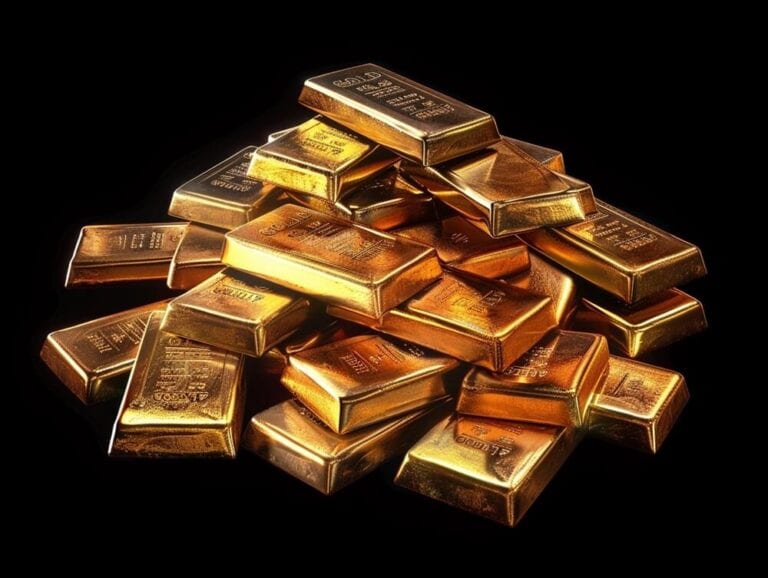
Gold bars represent one of the most tangible forms of precious metal investment. Their value depends on several key factors.
A standard one-ounce gold bar is currently worth around $2,536, while larger bars like the 400-ounce variety used by banks can be worth over $1 million. The price fluctuates daily based on market conditions and the spot price of gold.
Understanding gold bar values requires knowledge of weight measurements, current market prices, and additional premiums that dealers charge. Gold bars come in various sizes, from small 10-gram bars to massive 400-ounce institutional bars.
Each size category has different pricing structures and investment considerations. Whether someone is considering their first gold purchase or expanding an existing collection, knowing how to calculate gold bar values helps make informed investment decisions.
The gold market operates differently from stocks and bonds. Unique factors influence pricing and long-term value potential.
Key Takeaways
- Gold bar values are based on current spot prices plus small premiums that vary by size and brand
- Prices change daily with market conditions, and bars range from small 10-gram pieces to large 400-ounce institutional bars
- Understanding weight measurements and market factors helps investors make better purchasing decisions
How Gold Bar Value Is Determined
Gold bar value depends on three main factors: the current spot price of gold, additional premiums and fees charged by dealers, and the weight and purity of the specific bar. These elements work together to create the final price investors pay.
Spot Price and Market Value
The spot price of gold serves as the foundation for all gold bar pricing. This represents the current market price for immediate delivery of gold.
Gold prices change constantly throughout trading hours. Economic conditions, geopolitical events, and investor demand all influence these fluctuations.
The spot price determines what dealers call the “melt value” of a gold bar. This is the base worth of the gold content if the bar were melted down.
Current market conditions show:
- Gold prices reaching record highs in 2024
- A 1 oz gold bar worth well over $2,000
- Daily price changes affecting all gold bar values
Investors must check real-time gold prices before buying or selling. The spot price forms the baseline, but it’s never the final price paid.
Premiums, Fees, and Dealer Markups
All gold bars sell for more than their melt value. Dealers add a premium to cover their costs and profit margins.
Premium costs vary based on the bar’s brand, condition, and popularity. Well-known brands typically command higher premiums than generic bars.
Ready to Protect Your Retirement?
Request your free State-Specific Gold IRA information kit and take the first step toward securing your financial future with precious metals.
Free Gold IRA GuidePremium factors include:
- Manufacturing costs
- Dealer overhead expenses
- Brand reputation
- Market demand
- Bar condition
Smaller gold bars carry higher premiums per ounce than larger ones. A 1-gram bar might have a 20% premium, while a 1-kilogram bar might only add 3-5%.
Buying and selling premiums differ significantly. Investors typically receive less premium when selling than they paid when buying.
Weight and Purity Considerations
Gold bar weight is measured in troy ounces, not regular ounces. One troy ounce equals 31.1 grams, slightly more than a standard ounce.
Common gold bar sizes:
- 1 gram
- 1 troy ounce
- 10 troy ounces
- 1 kilogram (32.15 troy ounces)
Purity affects the actual gold content and value. Most investment-grade gold bars are .9999 fine gold, meaning 99.99% pure gold content.
The calculation is straightforward: multiply the bar’s troy ounce weight by the current spot price of gold. Then add applicable premiums to get the total cost.
Larger bars offer better value per ounce due to lower premiums. However, they require more capital upfront and can be harder to sell in smaller portions.
Current Gold Bar Prices by Weight
Gold bar prices vary significantly based on weight and size. 1 oz gold bars are worth over $2,000 at current market rates.
Larger bars like 1 kg options offer better value per ounce due to lower premiums.
1 oz Gold Bar Value
A 1 oz gold bar represents the most popular size for individual investors. These bars currently trade for approximately $2,300 or more, depending on the current spot price of gold.
How Much Will Your Gold IRA Really Cost?
See exactly how much you'll pay in setup, annual, and storage fees. Get personalized company recommendations based on your investment amount and retirement timeline.
Calculate My Total FeesThe price includes both the melt value and a premium above spot price. Premium costs for 1 oz bars typically range from 2% to 5% over spot price.
Key factors affecting 1 oz bar prices:
- Current gold spot price
- Brand reputation and mint
- Market demand and availability
- Dealer markup and fees
Popular 1 oz gold bars include products from PAMP Suisse, Credit Suisse, and Perth Mint. These established brands command slightly higher premiums due to their recognized quality and authenticity.
1 kg and Other Common Sizes
1 kg gold bars are worth approximately $74,943 based on current market conditions. These larger bars offer significantly lower premiums per ounce compared to smaller sizes.
Common gold bar sizes and approximate values:
| Weight | Troy Ounces | Approximate Value |
|---|---|---|
| 1 gram | 0.032 | $85-$95 |
| 10 grams | 0.321 | $850-$900 |
| 1 oz | 1.0 | $2,300-$2,400 |
| 100 grams | 3.215 | $8,500-$8,700 |
| 1 kg | 32.15 | $74,000-$75,000 |
The 400-oz gold bar is worth $1,322,120 and represents institutional-grade investment sizes. These large bars are typically held by banks and major investors.
Comparing Gold Bars to Gold Coins
Gold bars generally offer lower premiums than gold coins, making them more cost-effective for investors focused on gold content. Gold bars are better investments than gold coins for investors who want to save money on premiums.
Gold bars vs. gold coins comparison:
- Premiums: Bars typically 2-5% over spot, coins 5-10% or higher
- Liquidity: Both highly liquid, coins slightly more recognized
- Storage: Bars more efficient for large quantities
- Collectibility: Coins offer numismatic potential, bars focus on bullion value
Gold coins like American Eagles or Canadian Maple Leafs carry higher premiums due to their legal tender status and collectible appeal. Investors prioritizing maximum gold content per dollar typically choose bars over coins.
Factors Influencing Gold Bar Prices
Gold bar values fluctuate based on supply and demand dynamics in global markets, economic uncertainty and geopolitical tensions, and central bank policies that affect currency strength. These interconnected forces create the complex pricing environment that determines what investors pay for precious metals.
Supply, Demand, and Global Markets
Gold supply comes from mining operations and recycled gold from jewelry and electronics. Major producing countries include China, Australia, and Russia.
When mines face disruptions or production costs rise, supply decreases and prices typically increase. Investment demand drives much of the gold market activity.
Don't Pay More Taxes Than You Have To
The wrong Gold IRA choice could cost you thousands in unnecessary taxes. See exactly how much you'll pay in taxes with a Traditional vs. Roth Gold IRA. Compare both options side-by-side based on your age, income, and retirement timeline.
During market volatility, investors buy gold bars as a safe haven asset. Industrial demand for gold in electronics and jewelry also affects pricing, though to a lesser extent than investment demand.
Key supply factors:
- Mining production levels
- Recycling rates
- Production costs
- Environmental regulations
Key demand factors:
- Investment portfolio allocation
- Jewelry consumption
- Industrial applications
- Central bank purchases
Global markets connect buyers and sellers worldwide. The London Bullion Market Association sets standards for gold trading.
Spot price fluctuations occur constantly as traders react to news and market conditions.
Economic and Geopolitical Impacts
Economic uncertainty increases gold demand as investors seek stability. Inflation concerns push people toward precious metals because gold often maintains purchasing power when currencies weaken.
High inflation periods historically correlate with rising gold prices. Interest rates have an inverse relationship with gold prices.
Low interest rates make non-yielding assets like gold more attractive. High rates increase the opportunity cost of holding gold since investors can earn returns elsewhere.
Economic factors affecting gold:
- Inflation rates
- Interest rate changes
- Stock market performance
- Economic growth indicators
Geopolitical tensions create uncertainty that benefits gold prices. Trade wars, military conflicts, and political instability drive investors toward safe haven assets.
Brexit, US-China trade disputes, and regional conflicts have all impacted gold valuations. Currency volatility also influences gold demand.
Gold IRA Company Comparison Checklist
Before choosing a Gold IRA company, use our comprehensive checklist to compare fees, reputation, storage options, and customer service ratings.
Download ChecklistWhen major currencies like the US dollar weaken, gold becomes more attractive to international investors.
Role of Central Banks and Currency Strength
Central banks hold significant gold reserves and their buying or selling activities impact prices. Many central banks increased gold purchases in recent years to diversify away from US dollar holdings.
These institutional purchases can move markets substantially. The US dollar’s strength inversely affects gold prices since gold is priced in dollars globally.
A stronger dollar makes gold more expensive for holders of other currencies, reducing demand. Dollar weakness has the opposite effect.
Central bank influences:
- Reserve diversification strategies
- Gold purchase programs
- Monetary policy decisions
- Currency intervention activities
Federal Reserve policy decisions significantly impact gold markets. Quantitative easing programs that increase money supply often boost gold prices.
Hawkish monetary policy that strengthens the dollar typically pressures gold lower. Other major central banks like the European Central Bank and Bank of Japan also influence gold through their monetary policies.
Coordinated central bank actions can create substantial price movements in precious metals markets.
How to Calculate the Value of a Gold Bar
Calculating a gold bar’s value requires three key steps: finding the current spot price of gold, converting the bar’s weight to troy ounces, and adding the melt value plus any dealer premiums.
Each step plays a crucial role in determining the final worth of any gold bar.
Finding the Spot Price of Gold
The spot price of gold forms the foundation for all gold bar calculations. This price changes constantly throughout trading hours as global markets react to economic news and demand.
Investors should check current gold prices using reliable financial websites or precious metals dealers. Many sites offer real-time price updates that show gold’s value per troy ounce.
Reserved for Portfolios of $500K or More
Your portfolio qualifies you for an exclusive one-on-one web conference with a senior precious metals advisor, priority service, and direct access to strategies reserved for our most valued clients.
Request Your Exclusive GuideA gold price chart provides historical context and helps track price movements over time. These charts typically display prices in US dollars per troy ounce.
Popular price sources include:
- Precious metals dealer websites
- Financial news platforms
- Commodity trading websites
- Banking institutions
The spot price represents the current market value for immediate delivery of gold. This price serves as the baseline before adding any premiums or fees.
Converting Bar Weight to Troy Ounces
Gold bars come in various weights measured in grams, ounces, or kilograms. Converting these weights to troy ounces is essential since gold prices are quoted per troy ounce.
Common conversion factors:
- 1 troy ounce = 31.1035 grams
- 1 kilogram = 32.15 troy ounces
- 1 regular ounce = 0.911 troy ounces
For example, a 100-gram gold bar equals 3.215 troy ounces (100 ÷ 31.1035). A 1-kilogram bar contains 32.15 troy ounces.
Most gold bars display their weight prominently on the surface. Investors should verify this weight and use precise conversion calculations for accurate valuations.
Weight verification methods:
- Check stamped markings on the bar
- Use certified scales if available
- Refer to manufacturer specifications
- Consult dealer documentation
Estimating Melt Value and Adding Premiums
The melt value equals the troy ounce weight multiplied by the current spot price of gold. This represents the pure gold content value without any additional costs.
For a 1-ounce gold bar with gold priced at $2,000 per troy ounce, the melt value equals $2,000. A 10-ounce bar would have a melt value of $20,000.
Gold bar premiums vary based on size, brand, and condition. Smaller bars typically carry higher percentage premiums than larger ones.
Premium factors include:
Your Complete Gold IRA Beginner's Guide
No confusing jargon. No pressure. Just clear answers about how Gold IRAs work, what they cost, and whether they're right for your retirement. Get the facts before you invest.
Get Your Free Starter Guide- Bar size (smaller bars = higher premiums)
- Brand reputation and recognition
- Manufacturing quality and finish
- Market demand and availability
Dealers typically charge premiums ranging from 1% to 5% above melt value for gold bars. Bulk gold purchases often qualify for lower premiums per ounce.
A $2,000 melt value bar with a 3% premium would cost $2,060 total.
Investing in Gold Bars: What to Know
Gold bars offer direct exposure to precious metals with different cost structures than coins or ETFs. Storage requirements and liquidity vary significantly based on bar size and purity levels.
Gold Bars vs. Other Precious Metals Investments
Gold bars provide pure metal ownership without numismatic premiums that coins carry. Unlike gold ETFs, investors hold physical metal directly.
Physical Gold Comparison:
- Gold bars: Lower premiums, bulk storage needed
- Gold coins: Higher premiums, easier to sell small amounts
- Gold rounds: Mid-range premiums, limited recognition
Silver bars cost less per ounce but require more storage space. Platinum and palladium bars offer portfolio diversification but have smaller markets.
Gold bars come in weights from 1 gram to 400 ounces. Smaller bars have higher premiums per ounce but offer flexibility for partial sales.
Gold investment through bars works best for long-term holders who can store larger amounts securely. ETFs suit investors wanting gold exposure without storage concerns.
Premiums, Liquidity, and Storage Considerations
Gold bars carry premiums above spot price that vary by size and dealer. Larger bars typically have lower percentage premiums.
Typical Premium Ranges:
- 1 oz bars: 3-8% above spot
- 10 oz bars: 2-5% above spot
- 1 kg bars: 1-3% above spot
Storage costs add ongoing expenses. Home storage requires insurance and security measures.
Professional vault storage costs 0.5-2% annually. Liquidity depends on bar size and recognition.
Don't Choose Blindly
Selecting the right Gold IRA company is crucial for your retirement. Use our comprehensive comparison checklist to evaluate providers and make the best decision for your financial future.
Get Your ChecklistWell-known refiners like PAMP and Credit Suisse sell faster than unknown brands. Selling large bars requires finding buyers with sufficient capital.
Smaller bars offer more flexibility but higher transaction costs per ounce.
Gold IRAs and Retirement Planning
Gold IRAs allow gold bar ownership in tax-advantaged retirement accounts. IRS rules require approved storage facilities and specific purity standards.
- Minimum 99.5% purity
- Produced by approved refiners
- Stored in IRS-approved depositories
Gold IRAs charge setup fees, annual storage costs, and custodian fees. Total annual costs range from $200-500 plus storage fees.
Precious metals can comprise up to 100% of an IRA portfolio. Financial advisors typically recommend 5-10% allocation for diversification.
Gold bars in IRAs cannot be held personally until distribution. Early withdrawals before age 59½ incur 10% penalties plus income taxes.
Historical Trends and Long-Term Outlook
Gold prices have experienced dramatic shifts over the past 50 years, with key turning points driven by monetary policy changes and global economic events. The metal’s performance as a store of value continues to attract investors seeking portfolio diversification and protection against economic uncertainty.
Gold Price Movements Over Time
Gold’s price evolution shows distinct cycles spanning several decades. The most significant shift occurred in 1971 when President Nixon ended the gold standard, allowing prices to float freely from the fixed $35 per ounce rate.
The 1970s marked an explosive growth period. Gold soared from $35 to $850 per ounce by 1980, representing a 2,300% increase.
This surge was fueled by high inflation, oil crises, and economic uncertainty. The following two decades brought consolidation and decline.
Central banks became net sellers of gold reserves, flooding the market with supply. Prices remained largely stagnant between 1980 and 2000.
The 21st century ushered in a new bull market. Gold reached record highs during the 2008 financial crisis, climbing to $1,895 per ounce in 2011.
How Gold Performed During Every Stock Market Crash
See the data: when stocks dropped 19.4% in 2022, gold only fell 4.3%. Compare gold's downside protection across decades of market volatility and economic crises.
Compare Crash PerformanceThe metal later set new records, hitting $2,067 per ounce in 2020. Recent data shows gold trading at $3,328.47 per ounce as of July 2025, up 37.77% from the previous year.
Prospects for Gold as a Store of Value
Gold’s role as a store of value remains compelling despite market volatility. The metal has demonstrated its ability to preserve wealth during periods of currency debasement and economic turmoil.
Central banks have shifted from net sellers to net buyers since 2010. This change signals renewed confidence in gold’s monetary role.
Countries like China and Russia have significantly increased their gold reserves as part of diversification strategies. Investing in gold offers several advantages for long-term wealth preservation:
- Inflation hedge: Gold typically maintains purchasing power over time
- Portfolio diversification: Low correlation with stocks and bonds
- Crisis protection: Performs well during financial stress
Modern investment vehicles like gold ETFs have made the metal more accessible to retail investors. These funds hold over 3,000 tons of gold globally, representing significant market influence.
Future prospects depend on interest rates, inflation expectations, and geopolitical tensions. Gold price chart analysis suggests continued volatility with potential for long-term appreciation as global economic uncertainties persist.
Frequently Asked Questions
Gold bar values depend on weight, current spot prices, and dealer premiums. A 1 oz gold bar is worth well over $2,000, while larger bars like 400 oz bars cost significantly more due to their size.
What is the value of a 400 oz gold bar in US dollars?
A 400 oz gold bar is worth approximately $800,000 to $900,000 at current gold prices. The exact value changes daily based on gold’s spot price.
The most common gold bars are the 400 oz gold bars held by banks. These bars measure 7 x 4.38 x 3.25 inches and contain 400 troy ounces of gold.
Banks and large institutions typically trade these bars. Individual investors rarely purchase 400 oz bars due to their high cost and storage requirements.
Can an individual legally possess a gold bar?
Yes, individuals can legally own gold bars in the United States. There are no federal laws preventing private gold ownership.
People can buy gold bars from precious metal dealers, coin shops, and online retailers. They must pay applicable taxes on their purchases.
Plan Your Gold IRA Distributions Strategically
Calculate which ounces to sell, when to take distributions, and how to minimize tax impact. Get your personalized RMD strategy based on current gold prices and IRS tables.
Create My RMD PlanStorage is the buyer’s responsibility. Many owners use bank safety deposit boxes or private vault services for security.
What is the market price for a one kilogram gold bar?
A 1 kg gold bar is worth approximately $74,943. This price fluctuates with daily gold market movements.
One kilogram equals 32.15 troy ounces. A kilo bar measures 3.15 inches x 1.58 inches x 0.71 inches.
Dealers add premiums above the melt value. Kilo bars typically have lower premiums than smaller bars, making them cost-effective for larger investments.
How is the worth of a gold bar determined per gram?
Gold bar worth per gram equals the current gold spot price divided by 31.1 grams per troy ounce. This gives the melt value per gram.
Dealers then add premiums to the melt value. Small denomination bars with some weighing as low as 10 grams carry higher premiums per gram than larger bars.
A 1 gram gold bar costs as low as $129.71 including premiums. The premium percentage decreases as bar size increases.
What is the current price for a one ounce gold bar?
A 1 oz gold bar is worth well over $2,000. Gold prices are high in 2024, so expect to pay $2,300 or more for a one ounce bar.
The final price includes the gold’s melt value plus dealer premiums. Premiums vary by brand, condition, and dealer.
One ounce bars are popular with individual investors. They offer a balance between affordability and reasonable premium costs.
How does the value of a 100 oz gold bar compare in the market?
A 100 oz gold bar is worth approximately $230,000 to $260,000 at current gold prices. The exact value depends on daily spot price fluctuations.
These bars offer better value than smaller bars due to lower premiums per ounce. Large gold bars tend to be cheaper than smaller bars, since the premium cost of a gold bar decreases as its size increases.
Storage and liquidity become considerations with 100 oz bars. They require secure storage and may be harder to sell quickly than smaller denominations.




One More Thing...
If you're serious about protecting your retirement, get the complete Gold IRA guide. It's free, there's no obligation, and it could be one of the smartest financial decisions you make.
Get Your Guide