Moving retirement funds into a gold-backed IRA can protect savings from inflation and market volatility. Investors face an important choice between two methods.
A Gold IRA rollover involves moving funds from one retirement account to another with the investor temporarily handling the money. A Gold IRA transfer moves funds directly between custodians without the investor touching the money.
Understanding this distinction helps investors avoid costly mistakes and tax penalties.
The differences between rollovers and transfers affect everything from tax implications to processing times and fees. Rollovers offer more flexibility and provider choices but come with stricter IRS rules and potential tax risks.
Transfers provide a simpler, lower-risk path with fewer complications but may limit investment options.
This guide examines the mechanics of each method, compares their benefits and drawbacks, and provides practical steps for implementation. It also covers tax considerations, custodian selection, and common mistakes to avoid when moving funds into precious metals for retirement.
Key Takeaways
- Gold IRA rollovers give investors more control and flexibility but involve higher complexity and tax risks compared to transfers
- Transfers provide a safer, more direct path between custodians with lower fees but may offer fewer investment options
- The choice between rollover and transfer depends on individual preferences for control, risk tolerance, and specific retirement objectives
Understanding Gold IRAs
Gold IRAs allow investors to hold physical gold and other precious metals in their retirement accounts instead of traditional investments like stocks and bonds. These accounts follow specific IRS rules about which metals qualify and require special custodians to manage the physical assets.
What Is a Gold IRA?
A Gold IRA is a self-directed individual retirement account that holds physical precious metals as investments. Unlike regular IRAs that contain paper assets, Gold IRAs store actual gold coins, bars, and other approved metals in secure depositories.
The IRS requires Gold IRAs to use qualified custodians who specialize in precious metals. These custodians handle all transactions and ensure compliance with federal regulations.
Key Features:
- Must use IRS-approved custodian
- Stores physical metals in secure facilities
- Follows same contribution limits as traditional IRAs
- Available as traditional or Roth versions
Gold IRAs offer the same tax advantages as regular retirement accounts. Traditional Gold IRAs provide tax-deferred growth, while Roth Gold IRAs offer tax-free withdrawals in retirement.
Types of Gold Allowed in IRAs
The IRS has strict rules about which gold products qualify for IRAs. Only certain coins and bars meet the purity requirements of 99.5% gold content.
Approved Gold Coins:
- American Gold Eagle coins
- American Gold Buffalo coins
- Canadian Gold Maple Leaf coins
- Austrian Gold Philharmonic coins
Approved Gold Bars:
- Must be 99.5% pure gold minimum
- Produced by NYMEX or COMEX-approved refiners
- Include proper hallmarks and certifications
Collectible coins and jewelry do not qualify for Gold IRAs. The metals must be held by the custodian, not stored at home.
Ready to Protect Your Retirement?
Request your free State-Specific Gold IRA information kit and take the first step toward securing your financial future with precious metals.
Free Gold IRA GuideHow Gold IRAs Differ from Traditional IRAs
Gold IRAs require specialized custodians who understand precious metals regulations. Traditional IRAs use standard financial institutions that handle stocks, bonds, and mutual funds.
Storage Requirements: Gold IRAs need secure depository storage for physical metals. Traditional IRAs hold electronic records of paper investments.
Fees Structure: Gold IRAs typically charge higher fees including:
- Annual storage fees ($100-$300)
- Insurance costs
- Transaction fees for buying/selling metals
Traditional IRAs usually have lower annual fees and no storage costs.
Investment Options: Gold IRAs limit investments to IRS-approved precious metals. Traditional IRAs offer broader choices including stocks, bonds, ETFs, and mutual funds.
Both account types follow the same contribution limits and required minimum distribution rules after age 73.
What Is a Gold IRA Rollover?
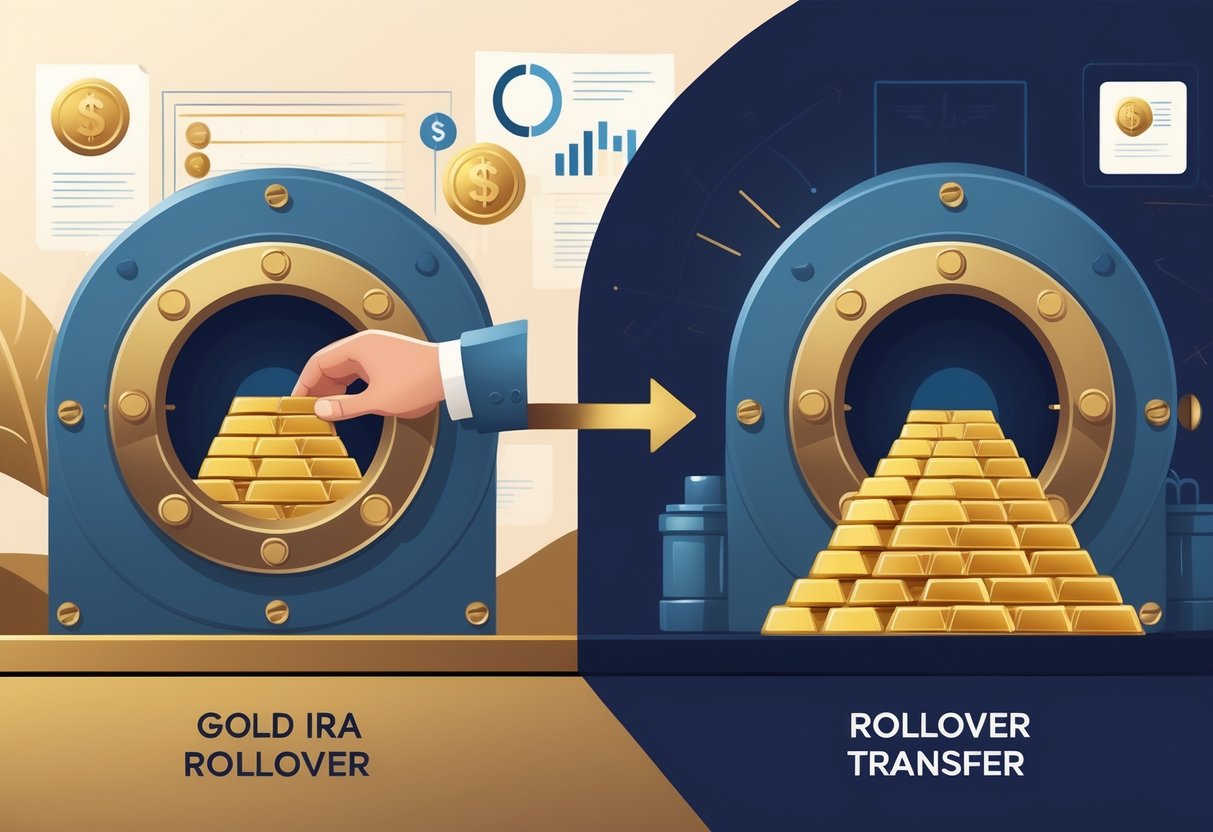
A gold IRA rollover allows investors to move funds from existing retirement accounts into a self-directed IRA that holds physical precious metals. This process can happen through direct transfers between custodians or indirect rollovers where investors temporarily receive the funds before depositing them into the new account within 60 days.
Direct Gold IRA Rollover Explained
A direct rollover moves funds straight from one retirement account to another without the investor touching the money. The original custodian sends the funds directly to the new gold IRA custodian.
This method eliminates tax complications. The investor never receives a check or has access to the funds during the transfer process.
Key Benefits:
- No tax withholding
- No 60-day deadline pressure
- Lower risk of penalties
- Unlimited frequency per year
Direct rollovers offer a streamlined way to move retirement savings without creating a taxable event. Most financial experts recommend this approach for its simplicity and safety.
The process typically takes 2-4 weeks to complete. The investor fills out paperwork with the new custodian, who handles all communication with the old account provider.
Indirect Rollover and the 60-Day Rule
An indirect rollover occurs when investors receive retirement funds directly before depositing them into a new account. The original custodian cuts a check to the account holder rather than the new custodian.
The 60-day rule requires investors to complete the rollover within 60 days of receiving the distribution. Missing this deadline creates a taxable event plus potential penalties.
How Much Will Your Gold IRA Really Cost?
See exactly how much you'll pay in setup, annual, and storage fees. Get personalized company recommendations based on your investment amount and retirement timeline.
Calculate My Total FeesImportant Restrictions:
- Only one indirect rollover per 12-month period
- 20% tax withholding on distributions
- Must deposit the full original amount, including withheld taxes
The IRS may waive the 60-day deadline in specific circumstances like bank errors or natural disasters. However, these waivers require extensive documentation and approval.
This method gives investors temporary access to their retirement funds but carries significant risk if not completed properly.
Eligible Accounts for Rollover
Multiple retirement account types qualify for gold IRA rollovers. Each account type has specific rules governing the rollover process.
Eligible Account Types:
- Traditional IRAs
- 401(k) plans from current or former employers
- 403(b) plans
- 457 plans
- Thrift Savings Plans (TSP)
- SEP-IRAs
- SIMPLE IRAs
Employer-sponsored plans like 401(k)s often require employees to leave their job before initiating a rollover. Some plans allow in-service distributions for workers over age 59½.
Traditional IRAs can roll over to gold IRAs without restrictions. The funds maintain their tax-deferred status throughout the process.
Roth accounts require special consideration. Roth 401(k) funds must roll into a Roth gold IRA to preserve their tax-free status.
Converting traditional retirement funds to a Roth gold IRA creates an immediate tax liability.
Mechanics of a Gold IRA Transfer
A Gold IRA transfer involves moving funds directly between custodians without the account holder handling the money. This process uses either custodian-to-custodian or trustee-to-trustee methods and works with various account types including traditional IRAs and Roth IRAs.
How a Custodian-to-Custodian Transfer Works
A custodian-to-custodian transfer moves retirement funds directly between financial institutions without tax consequences. The account holder never receives the money during this process.
The current IRA custodian sends funds electronically to the new custodian. This method eliminates the 60-day deadline that applies to rollovers.
Key Steps:
- Account holder completes transfer paperwork with the new custodian
- New custodian contacts the old custodian to request funds
- Funds move directly between institutions
- No tax withholding occurs during the transfer
Most Gold IRA transfers use this direct movement method to avoid complications. The process typically takes 2-4 weeks to complete.
Don't Pay More Taxes Than You Have To
The wrong Gold IRA choice could cost you thousands in unnecessary taxes. See exactly how much you'll pay in taxes with a Traditional vs. Roth Gold IRA. Compare both options side-by-side based on your age, income, and retirement timeline.
Account holders can initiate multiple transfers per year without IRS restrictions. This flexibility makes transfers more appealing than rollovers for frequent account changes.
Trustee-to-Trustee Transfer Process
A trustee-to-trustee transfer works similarly to custodian transfers but involves trustees managing the account assets. Banks, credit unions, and investment firms often serve as trustees.
The trustee receives written instructions from the account holder to transfer funds. They then coordinate directly with the receiving trustee to complete the move.
Transfer Documentation Required:
- Signed transfer request form
- Account statements from both institutions
- Beneficiary information
- Investment direction for new account
Self-directed IRA trustees handle precious metals investments differently than traditional trustees. They must ensure compliance with IRS rules for physical gold storage.
The receiving trustee confirms account setup before accepting funds. This verification prevents delays and ensures proper account classification.
Processing times vary by institution but typically range from 1-3 weeks. Complex transfers involving physical assets may take longer.
Transfer Eligibility and Account Types
IRA transfers work between most retirement account types with similar tax treatment. Traditional IRAs can transfer to other traditional IRAs without tax consequences.
Eligible Account Types:
- Traditional IRA to Traditional IRA
- Roth IRA to Roth IRA
- SEP-IRA to Traditional IRA
- SIMPLE IRA to Traditional IRA (after 2-year waiting period)
Roth IRA transfers maintain their tax-free status when moving to another Roth account. Mixing Roth and traditional funds creates tax complications.
Employer-sponsored plans like 401(k)s require rollovers rather than transfers. These accounts cannot use the direct transfer method between custodians.
Self-directed IRAs accept transfers from traditional IRAs and other self-directed accounts. The new custodian must specialize in alternative investments like precious metals.
Transfer Restrictions:
Gold IRA Company Comparison Checklist
Before choosing a Gold IRA company, use our comprehensive checklist to compare fees, reputation, storage options, and customer service ratings.
Download Checklist- No mixing of pre-tax and after-tax funds
- Required minimum distributions must continue during transfers
- Beneficiary IRAs have special transfer rules
Some custodians charge transfer fees ranging from $25 to $100. Account holders should verify these costs before initiating transfers.
Key Differences: Gold IRA Rollover vs. Transfer
Gold IRA rollovers and transfers operate under different IRS rules, with rollovers having stricter timing limits and transfer methods affecting the account holder’s involvement level. These differences impact tax implications and penalty risks for retirement investors.
Rules and IRS Regulations
IRS rules treat rollovers and transfers differently for tax purposes. A rollover involves the account holder receiving funds and redepositing them within 60 days, while transfers move funds directly between custodians.
Rollover Rules:
- Must complete within 60 days to avoid tax penalties
- Funds are temporarily in the account holder’s possession
- Subject to mandatory 20% tax withholding on distributions from employer plans
Transfer Rules:
- No time limits for completion
- Funds never touch the account holder’s hands
- No mandatory tax withholding applies
Tax penalties apply if rollover rules are violated. Missing the 60-day deadline triggers income tax on the entire amount plus potential early withdrawal penalties for account holders under age 59½.
Transfers are generally safer and have fewer restrictions than rollovers, making them less risky from a compliance standpoint. The IRS treats properly executed transfers as non-taxable events with no reporting requirements.
Timing and Frequency Limitations
The IRS imposes strict timing rules that create significant differences between these two methods. IRS regulations limit rollovers to once per year, while transfers have no such restrictions.
Rollover Limitations:
- One rollover per 12-month period per account
- 60-day completion requirement
- Violation results in tax penalties and early withdrawal penalty if under age 59½
Transfer Freedom:
- Unlimited number of transfers allowed
- No time restrictions for completion
- Can be done multiple times throughout the year
The one-rollover-per-year rule applies across all IRA accounts owned by the same person. Completing a rollover from any IRA prevents another rollover for 12 months.
Early withdrawal penalties of 10% apply to failed rollovers for account holders under age 59½. This penalty combines with regular income tax on the distributed amount.
Involvement of IRA Holder
The level of account holder involvement differs significantly between these two methods. Rollovers require active participation while transfers operate independently.
Rollover Process:
- Account holder receives distribution check or funds
- Must deposit funds into new account within 60 days
- Requires careful tracking of deadlines and tax implications
- Higher risk of errors due to direct involvement
Transfer Process:
Reserved for Portfolios of $500K or More
Your portfolio qualifies you for an exclusive one-on-one web conference with a senior precious metals advisor, priority service, and direct access to strategies reserved for our most valued clients.
Request Your Exclusive Guide- Custodians handle the entire transaction
- Account holder signs authorization forms only
- No direct handling of retirement funds
- Lower risk of compliance mistakes
The difference in involvement affects tax implications. Rollovers create temporary taxable events that must be reversed through proper redeposit.
Transfers avoid this issue entirely. Account holders bear full responsibility for rollover compliance.
Missing deadlines or making errors results in immediate tax consequences and potential early withdrawal penalties.
Tax Implications and Penalties
Understanding the tax consequences of Gold IRA rollovers versus transfers is crucial for retirement planning. The method you choose can trigger different tax events, penalties, and benefits that directly impact your financial future.
Potential Taxable Events
Indirect rollovers create the highest risk for taxable events. When you receive funds directly from your retirement account, you have 60 days to deposit the full amount into your Gold IRA.
Missing this deadline turns your rollover into a distribution. The IRS treats the entire amount as taxable income for that year.
Direct transfers between custodians avoid taxable events entirely. The funds never touch your hands, so there are no tax consequences or penalties.
Multiple indirect rollovers also trigger tax problems. The IRS allows only one indirect rollover per 12-month period across all your IRAs.
Key taxable scenarios:
- Funds not redeposited within 60 days
- Multiple indirect rollovers in one year
- Improper storage of gold at home
- Using a non-approved custodian
Avoiding Early Withdrawal Penalties
The 10% early withdrawal penalty applies to distributions before age 59½. This penalty hits hard when combined with regular income taxes.
Gold IRA transfers protect against rollover penalties since funds move directly between custodians. You never risk missing deadlines or triggering distributions.
Example: A 55-year-old withdraws $50,000 from their 401(k) but misses the 60-day redeposit deadline. They face $5,000 in penalties plus income tax on the full amount.
Penalty avoidance strategies:
- Choose direct transfers over indirect rollovers
- Use approved custodians only
- Store gold at IRS-approved depositories
- Complete transfers within required timeframes
Tax Benefits of Gold IRAs
Gold IRAs maintain the same tax advantages as traditional retirement accounts. Your investments grow tax-deferred until you take distributions in retirement.
Your Complete Gold IRA Beginner's Guide
No confusing jargon. No pressure. Just clear answers about how Gold IRAs work, what they cost, and whether they're right for your retirement. Get the facts before you invest.
Get Your Free Starter GuideTraditional Gold IRA benefits:
- Tax-deductible contributions
- Tax-deferred growth
- Lower tax rates in retirement
Roth Gold IRA benefits:
- Tax-free growth
- Tax-free qualified withdrawals
- No required minimum distributions
Gold IRA transfers ensure seamless transitions without immediate tax implications. This preserves your tax-advantaged status while diversifying into precious metals.
The diversification benefits help protect against inflation while maintaining your retirement account’s tax structure. Gold often performs well during economic uncertainty when traditional investments struggle.
Choosing Between Rollover and Transfer
Your investment strategy and timeline determine which method works best for moving retirement funds into precious metals. The decision depends on your current account type, how quickly you need access to funds, and your long-term retirement savings goals.
Assessing Your Investment Strategy
Different investment methods require different approaches when moving funds into gold IRAs. Investors with employer-sponsored 401(k) plans typically need rollovers since they’re moving between different account types.
Those already holding traditional or Roth IRAs can use transfers. This method keeps the same account structure while changing custodians.
Active traders benefit from transfers because they can move funds multiple times per year without restrictions. This flexibility supports frequent portfolio adjustments.
Conservative investors often prefer rollovers for their structured approach. The process involves more oversight and documentation, which some find reassuring.
Gold investment through either method requires understanding IRS rules. Transfers avoid reporting requirements, while rollovers must be reported even when no taxes are due.
Long-Term Considerations
Long-term retirement objectives influence the choice between methods. Transfers offer unlimited frequency, making them ideal for investors who adjust their retirement savings regularly.
Rollovers work better for one-time moves from employer plans to self-directed accounts. This approach suits investors planning to hold gold for decades without frequent changes.
Tax implications differ significantly over time. Transfers never trigger tax events when done correctly.
Rollovers can create tax complications if the 60-day rule isn’t followed. Fee structures vary between methods.
Don't Choose Blindly
Selecting the right Gold IRA company is crucial for your retirement. Use our comprehensive comparison checklist to evaluate providers and make the best decision for your financial future.
Get Your ChecklistSome custodians charge different rates for rollovers versus transfers. Compare costs over your expected holding period.
Long-term investment strategy should account for required minimum distributions. Gold IRAs must follow the same RMD rules as traditional retirement accounts.
When to Use a Rollover vs. a Transfer
The best funding method depends on your current account type and specific circumstances. Use rollovers when moving from 401(k), 403(b), or other employer-sponsored plans.
Choose rollovers when:
- Moving from employer plans to IRAs
- Switching from traditional to Roth accounts
- You need temporary access to funds (60-day window)
- Making your first move to precious metals
Choose transfers when:
- Moving between IRA custodians
- You want unlimited frequency
- Avoiding all tax reporting requirements
- Maintaining existing account tax status
Account structures and preferences for flexibility versus simplicity guide the decision. Transfers offer more flexibility but require compatible account types.
Emergency situations favor rollovers since they provide temporary access to funds. This 60-day window can help during financial difficulties, though it carries risks if not completed properly.
Selecting a Gold IRA Custodian or Company
Choosing the right custodian determines the success of your gold IRA investment. The custodian’s experience, fees, and reputation directly impact your retirement savings growth and security.
Importance of Working With Experienced Providers
Working with experienced gold IRA providers protects your retirement funds from costly mistakes and compliance issues. Experienced Gold IRA companies understand IRS rules and can guide investors through complex paperwork requirements.
New or inexperienced providers may lack proper insurance coverage or storage facilities. They might also charge hidden fees that eat into your investment returns.
Key benefits of experienced providers:
- Proven track record with thousands of successful transfers
- Established relationships with IRS-approved depositories
- Clear fee structures with no hidden costs
- Dedicated customer support teams
Experienced gold IRA companies also maintain proper licensing and regulatory compliance. They typically offer educational resources to help investors understand precious metals investing.
Evaluating Gold IRA Companies
Gold IRA companies vary significantly in their fees, services, and investment options. Smart investors compare multiple providers before making decisions.
Essential factors to evaluate:
| Factor | What to Look For |
|---|---|
| Fees | Annual fees under $200, transparent pricing |
| Storage | IRS-approved depositories, segregated storage options |
| Product Selection | Wide variety of approved coins and bars |
| Customer Service | Dedicated account representatives, educational support |
Many gold IRA providers offer promotions like waived fees for the first year. However, investors should focus on long-term costs rather than short-term incentives.
How Gold Performed During Every Stock Market Crash
See the data: when stocks dropped 19.4% in 2022, gold only fell 4.3%. Compare gold's downside protection across decades of market volatility and economic crises.
Compare Crash PerformanceCheck the company’s Better Business Bureau rating and online reviews. Look for companies that have been in business for at least five years.
Role of the Gold IRA Custodian
The gold IRA custodian handles all administrative duties and ensures IRS compliance for your account. They process transactions, maintain records, and coordinate with storage facilities.
IRA custodians must be approved by the IRS and maintain proper licensing. They cannot provide investment advice but can explain available options and procedures.
Primary custodian responsibilities:
- Processing buy and sell orders
- Maintaining account records and statements
- Coordinating with approved depositories
- Handling required minimum distributions
- Filing necessary tax documents
Some custodians specialize in precious metals while others handle various alternative investments. Specialized custodians often provide better service and lower fees for gold IRA investors.
The custodian charges annual fees ranging from $50 to $300. They may also charge transaction fees for each purchase or sale of precious metals.
Frequently Asked Questions
Understanding the tax implications and procedural differences between Gold IRA transfers and rollovers helps investors make informed decisions. These common questions address timing requirements, penalty structures, and the various methods available for moving retirement funds.
What are the differences between an IRA transfer and IRA rollover?
An IRA transfer involves direct movement of funds between custodians without the account holder handling the money. The funds never touch the investor’s hands during this process.
A rollover requires the account holder to receive funds from one retirement account and redeposit them into another account. This method gives temporary access to the funds but creates timing requirements.
Rollovers involve withdrawing funds from existing retirement accounts and redepositing them into a self-directed Gold IRA. Transfers happen directly between financial institutions.
The key difference lies in who controls the funds during the process. Transfers eliminate the risk of missing deadlines or incurring penalties.
Can I transfer my IRA from one institution to another without incurring taxes?
Yes, IRA transfers between custodians typically avoid tax consequences when completed properly. The direct movement of funds from one trustee to another maintains the tax-advantaged status of the retirement account.
Transfers do not count against annual rollover limits. Investors can complete multiple transfers in a single year without triggering tax penalties.
The funds never become taxable income because they remain within the retirement account structure. This makes transfers an efficient method for changing investment options or custodians.
Are there any penalties associated with moving money from a 401k to an IRA?
Moving money from a 401k to an IRA through a direct rollover typically avoids penalties when done correctly. The funds must move directly from the 401k administrator to the IRA custodian.
Plan Your Gold IRA Distributions Strategically
Calculate which ounces to sell, when to take distributions, and how to minimize tax impact. Get your personalized RMD strategy based on current gold prices and IRS tables.
Create My RMD PlanIf the 401k provider does not allow direct transfers, investors may need to do a rollover. This creates a 60-day window to complete the transaction.
Early withdrawal penalties apply if funds are not redeposited within the required timeframe. These penalties can be 10% of the withdrawn amount for investors under age 59½.
Employers may withhold 20% for taxes on indirect rollovers. This withholding must be made up by the investor to avoid partial taxation.
What are the potential disadvantages of conducting a 401k to IRA rollover?
The 60-day deadline creates significant risk for indirect rollovers. Missing the 60-day rollover deadline results in the entire distribution becoming taxable income.
Investors lose access to certain 401k benefits after completing a rollover. These may include loan options, early withdrawal exceptions, and institutional investment rates.
The complexity of the rollover process increases compared to direct transfers. More paperwork and coordination between institutions creates opportunities for errors.
Tax withholding on indirect rollovers creates cash flow challenges. Investors must replace the withheld amount from other sources to avoid partial taxation.
What is a direct rollover and how does it differ from a 60-day rollover?
A direct rollover moves funds directly from one retirement account to another without the account holder receiving the money. The funds transfer between custodians electronically or by check made payable to the new institution.
A 60-day rollover involves withdrawing funds and must be completed within 60 days to avoid taxes and penalties. The investor receives the funds and takes responsibility for redepositing them.
Direct rollovers avoid the 60-day deadline and eliminate withholding requirements. This method reduces administrative burden and tax complications.
The 60-day method gives investors temporary access to their funds but creates strict timing requirements. Late deposits result in permanent tax consequences.
What is the process for a trustee-to-trustee transfer in the context of IRA accounts?
A trustee-to-trustee transfer begins with opening an account at the new custodian. The investor completes transfer paperwork requesting the movement of funds from the current custodian.
The new custodian contacts the old custodian to initiate the transfer process. Both institutions coordinate to move the funds directly without involving the account holder.
The transfer typically takes 1-3 weeks to complete depending on the institutions involved. Some custodians may charge transfer fees for outgoing funds.
The funds maintain their tax-advantaged status throughout the process. No taxes or penalties apply when the transfer is completed properly between qualified custodians.




One More Thing...
If you're serious about protecting your retirement, get the complete Gold IRA guide. It's free, there's no obligation, and it could be one of the smartest financial decisions you make.
Get Your Guide