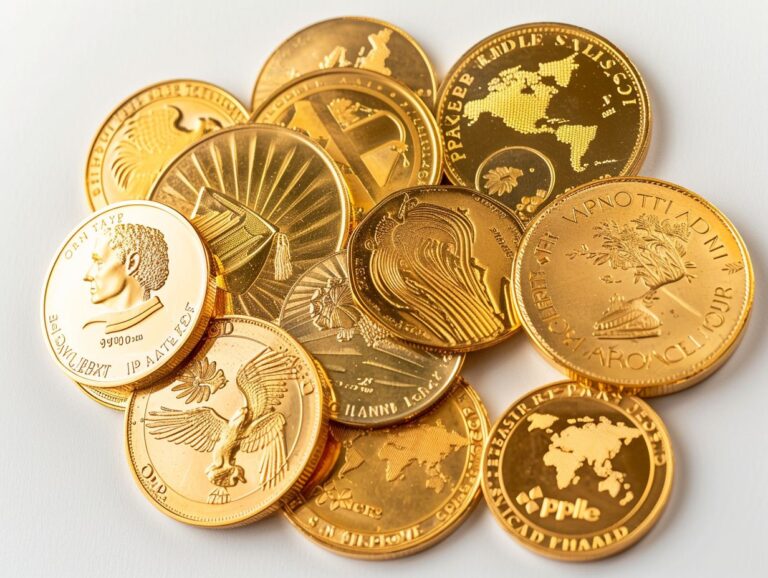
Gold bullion is physical gold valued for its precious metal content and current market value rather than for craftsmanship or rarity. Gold bullion appears in two main forms, which are gold bars (1 gram to 400 troy ounces) and bullion coins (American Gold Eagle, Canadian Gold Maple Leaf). Government mints (U.S. Mint, Royal Canadian Mint) strike bullion coins with a stated weight and purity. Refiners (Valcambi, PAMP) pour or cut bars that carry a serial number and an assay stamp.
Acco evaluate gold bullion by weight, fineness, mint or refiner reputation, premium over spot price, and buyback terms. Investment-grade gold bars carry a fineness of 99.5% to 99.99%, which means 995 to 999.9 parts of pure gold per 1,000. Premiums range from 1% to 20% over the spot price, depending on weight and product type. Resale value depends on the spot price at the time of sale minus the dealer buyback spread. Gold bullion holds relevance for physical gold investments, since the metal value follows the global spot price per troy ounce. Gold IRAs hold IRS-approved bullion (American Gold Eagle coins, 99.5% fine bars) inside a custodian-administered retirement account.
What is Gold Bullion?
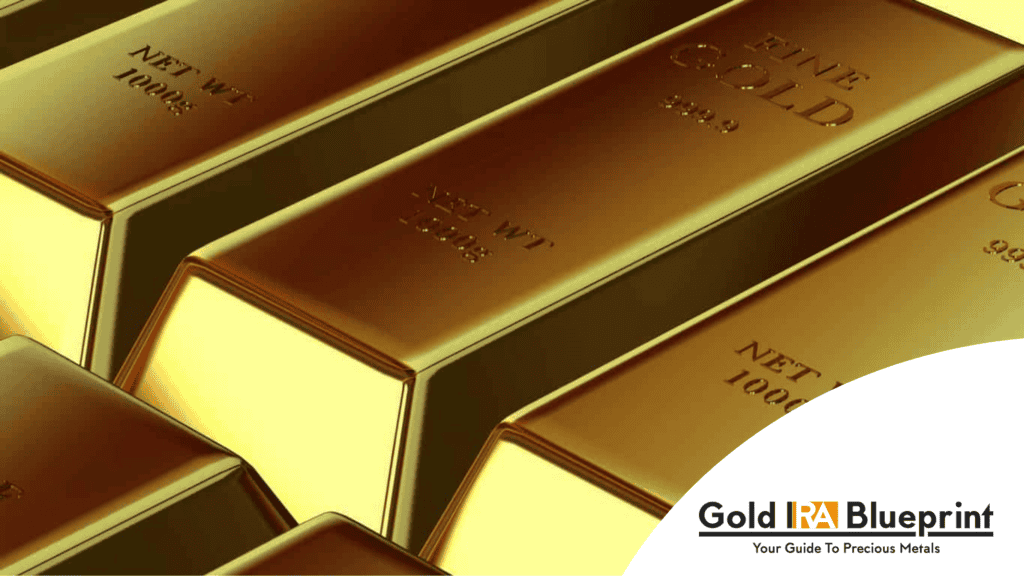
Gold bullion is physical gold in bar, coin, or ingot form that carries a value tied to its precious metal content. The value follows the spot price, and the LBMA Gold Price benchmark is set twice daily in London. Gold bars range from 1 gram to 400 troy ounces (1 ounce, 10 ounces, 1 kilogram), and each bar carries a stamped weight, fineness, and serial number. Bullion coins (American Gold Eagle, Canadian Gold Maple Leaf, South African Krugerrand) carry a symbolic face value, and the gold content sets the price. Jewelry prices reflect craftsmanship, brand, and styling, so the retail price exceeds the melt value of the gold. Collectible gold (Saint Gaudens Double Eagles, rare date Liberty Head coins) trades on rarity, condition grade, and numismatic demand rather than on weight alone.
Ready to Protect Your Retirement?
Request your free State-Specific Gold IRA information kit and take the first step toward securing your financial future with precious metals.
Free Gold IRA GuideHow does Gold Bullion differ from Gold Coins?
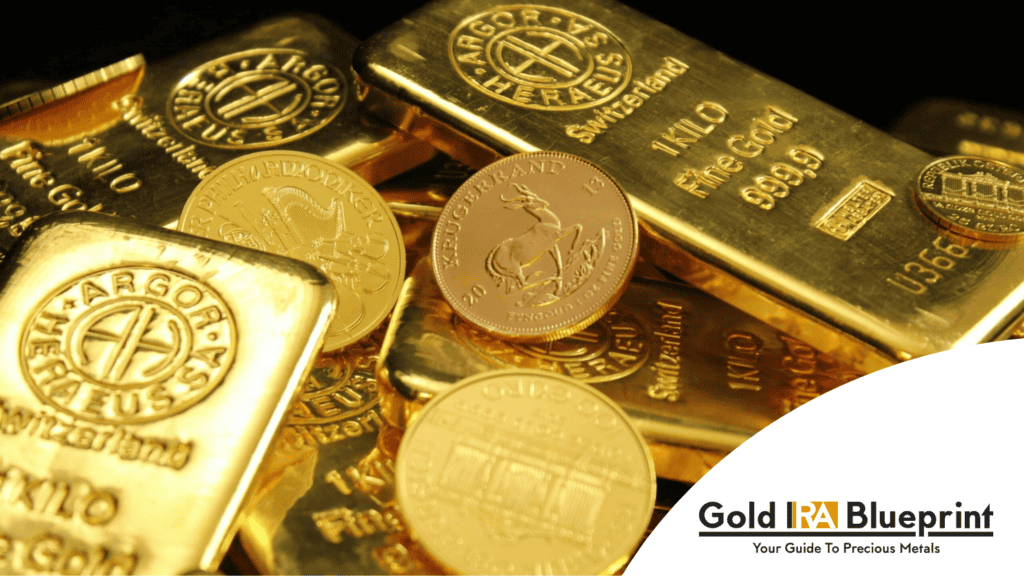
Gold bullion differs from gold coins by format, weight range, premium, storage, and resale terms. Bars come in sizes from 1 gram to 400 troy ounces with a refiner stamp. Coins (American Gold Eagle, Canadian Gold Maple Leaf) come in 1/10 ounce, 1/4 ounce, 1/2 ounce, and 1 ounce sizes with a government-issued face value. Coin premiums run 3% to 8% over spot for 1-ounce sizes, and large bars run 0.5% to 3%. Bars take less storage space per ounce, and coins resell in smaller increments. Each format holds investment-grade gold of 91.67% to 99.99% fineness. Investors weigh premium, storage, and liquidity when selecting bars or gold coins.
How Much Will Your Gold IRA Really Cost?
See exactly how much you'll pay in setup, annual, and storage fees. Get personalized company recommendations based on your investment amount and retirement timeline.
Calculate My Total FeesWhat Gold Purity Levels are Common in Gold Bullion?
The common gold purity levels in gold bullion are 99.5% (995 fineness), 99.9% (999 fineness), 99.99% (9999 fineness), and 91.67% (22 karat). Fineness measures pure gold in parts per 1,000, so a 999.9 fineness bar holds 999.9 grams of gold per 1,000 grams. Karat measures purity on a 24-point scale, so 22-karat gold equals 91.67%. The Royal Canadian Mint strikes the Gold Maple Leaf at 99.99% fineness, and the U.S. Mint strikes the American Gold Eagle at 91.67%. Purity differs from total weight, so a 10-gram bar at 99.5% fineness holds 9.95 grams of pure gold. Buyers verify the stamped fineness, the assay card, and the refiner or mint name to confirm gold purity.
What Determines the Price of a Gram of Gold Bullion?

Don't Pay More Taxes Than You Have To
The wrong Gold IRA choice could cost you thousands in unnecessary taxes. See exactly how much you'll pay in taxes with a Traditional vs. Roth Gold IRA. Compare both options side-by-side based on your age, income, and retirement timeline.
The spot price adjusted for purity and product premium determines the price of a gram of gold bullion. The market price of gold is listed per troy ounce, which equals 31.1035 grams. Division of the spot price by 31.1035 converts the quote to a per-gram value, so a [$3,000] spot price equals [$96.45] per gram. Fineness adjusts the value, since a 99.5% bar holds [$95.97] of gold per gram at the same spot price. Product premiums add 1% to 20%, depending on weight, mintage, and dealer inventory. The formula for the final price per gram is spot price per gram multiplied by fineness and by 1 plus the premium rate. Dealers update the quote throughout the trading day, since the spot price moves with the London and New York markets.
How does Gold Bullion Pricing Vary by Weight?
Gold bullion pricing varies by weight by scaling the metal value with ounces and by reducing the premium per ounce on larger products. A 1-ounce bar at a [$3,000] spot price carries a metal value of [$3,000], and a 10-ounce bar carries [$30,000]. Premiums per ounce fall as weight rises, with 1-gram bars at 10% to 20% and 10-ounce bars at 1% to 2%. Fixed costs (minting, assay, packaging, shipping) spread across a larger gold weight on big products, which lowers the cost per gram. Large products (1 kilogram, 400-ounce Good Delivery bars) trade near the spot price, with the LBMA Good Delivery standard governing 400-ounce bars.
Gold IRA Company Comparison Checklist
Before choosing a Gold IRA company, use our comprehensive checklist to compare fees, reputation, storage options, and customer service ratings.
Download ChecklistWhy does Gold Bullion Cost More Than the Spot Price of Gold?
Gold bullion costs more than the spot price of gold because premiums cover minting, refining, distribution, and dealer margins on top of the metal value. Minting or manufacturing costs include refining, assay, stamping, packaging, and insurance, which run 1% to 3% on 1-ounce products. Distribution costs include freight, secure storage, and wholesale handling from mints to dealers. Dealer margins add 0.5% to 2% on large bars and 3% to 10% on small coins. Premiums rise during supply shortages, as seen in 2020 when 1-ounce coin premiums passed 10%. The metal value equals the spot price times weight and fineness, and the retail price equals that value and the premium.
How Can Investors Buy Gold Bullion From a Reputable Dealer?
Investors can buy gold bullion from a reputable dealer by verifying credentials, comparing posted prices to the spot price, and confirming product specifications and return policies. Dealer reputation shows in the Better Business Bureau rating, years in business, and verified customer reviews on independent platforms. Product specifications list weight, fineness, mint or refiner name, and year of issue, matching the stamp on the item. Pricing transparency means a posted price tied to the live spot price, a stated premium, and no hidden fees on shipping, insurance, or handling. Authentication documentation includes assay cards for bars, mint-sealed packaging for coins, serial numbers, and an itemized invoice listing the weight and date. Transaction policies cover the payment methods accepted, the price lock window of 10 to 30 minutes, the return period, and the written buyback terms.
Reserved for Portfolios of $500K or More
Your portfolio qualifies you for an exclusive one-on-one web conference with a senior precious metals advisor, priority service, and direct access to strategies reserved for our most valued clients.
Request Your Exclusive GuideWhat Should Buyers Check Before Purchasing Gold Bullion?
Buyers should check weight, fineness, mint or refiner, price, documents, and buyback terms before purchasing gold bullion. Each check confirms the product matches the stated specifications and price.
Buyers follow the six steps listed below before purchasing gold bullion.
Your Complete Gold IRA Beginner's Guide
No confusing jargon. No pressure. Just clear answers about how Gold IRAs work, what they cost, and whether they're right for your retirement. Get the facts before you invest.
Get Your Free Starter Guide- Confirm the weight. The stated weight appears on the bar or coin in grams or troy ounces (1 troy ounce equals 31.1035 grams). A scale reading within 0.1 gram of the stamp supports authenticity. Weight sets the metal value at the spot price.
- Verify the fineness. The stamped fineness (999.9, 995, 916.7) states the pure gold share per 1,000 parts. Buyers match the stamp to the product listing and the assay card. A mismatch signals a different product grade.
- Check the mint or refiner. Recognized sources include the U.S. Mint, Royal Canadian Mint, Perth Mint, PAMP, and Valcambi. LBMA Good Delivery listing marks a refiner that meets the London market standard. Sealed packaging from the source confirms the origin.
- Compare the price. The total price equals the spot price times weight and fineness, plus the premium. Buyers compare the premium percentage across three listings. A 15% premium on a 1-ounce coin adds [$450] at a [$3,000] spot price.
- Request the documentation. Documentation includes the assay card, serial number record, and itemized invoice with the date and weight. Sealed mint packaging (tubes, monster boxes, blister cards) preserves the original condition. Records support resale value and insurance claims.
- Review the buyback terms. Buyback terms state the bid price formula (spot price minus 1% to 3% on 1-ounce coins), the payment method, and the settlement time. Written terms prevent disputes at resale. Buyers confirm whether the dealer repurchases products bought elsewhere.
How Can Gold Bullion Be Sold or Converted Into Cash?
Gold bullion can be sold or converted into cash by selling to a dealer buyback desk, a local coin shop, a refiner, or a private buyer. Dealer buyback arrangements quote a bid price based on the live spot price, weight, fineness, and product condition. Valuation starts with an assay or scale check, and recognized products (American Gold Eagle, Canadian Gold Maple Leaf) clear the check faster. The quoted market price equals the spot price. The amount a seller receives equals the bid price, which sits 0.5% to 5% below spot. Sellers receive payment by wire, check, or store credit within 1 to 5 business days after the dealer verifies the product.
How Does the Gold Bullion Market Work?
The gold bullion market works by matching buyers and sellers across the London over-the-counter market, COMEX futures in New York, and regional retail dealers. Mines and recyclers supply raw gold to refiners (Valcambi, PAMP, Perth Mint), which cast bars to the 99.5% to 99.99% standard. Government mints (U.S. Mint, Royal Canadian Mint) buy gold and strike coins that distributors sell to dealers. Wholesale trades settle in 400 troy ounce LBMA Good Delivery bars at prices set from the spot price, with narrow premiums. Retail transactions occur in 1 gram to 1 kilogram sizes at the spot price and a premium of 1% to 20%. Central banks (People’s Bank of China, National Bank of Poland) and investors drive demand at the wholesale level. Dealers bridge the two levels by buying wholesale bars and selling retail sizes.
How do Gold Bullion Dealers Make Money?
Gold bullion dealers make money by charging premiums over the spot price, keeping a bid-ask spread, and adding fees for shipping, insurance, and payment processing. The bid-ask spread is the gap from the dealer buy price to the dealer sell price, and the spread runs 2% to 6% on common coins. Other charges include shipping of [$10 to $50] per order, insurance of 0.5% to 1% of order value, and credit card fees of 2% to 4%. Buyers pay the premium (1% to 8%) and fees on top of the spot price, so the cost basis sits above the metal value. Sellers receive the bid price, so proceeds fall below the metal value by the spread.
Don't Choose Blindly
Selecting the right Gold IRA company is crucial for your retirement. Use our comprehensive comparison checklist to evaluate providers and make the best decision for your financial future.
Get Your ChecklistWhat Factors Influence Gold Bullion Prices?
The factors that influence gold bullion prices are gold supply and demand, interest rates, currency movements, investor sentiment, and geopolitical uncertainty. Supply comes from mine output above 3,500 metric tons a year and recycling, and demand comes from jewelry, central banks, and investors. Higher interest rates raise the opportunity cost of holding gold, and lower rates support prices. Investor sentiment shifts and geopolitical uncertainty (trade tensions, armed conflicts) lift safe haven demand for gold. Product-specific premiums (mint, weight, dealer inventory) differ from market influences, since the premium changes the retail price but not the spot price.
How does Gold Bullion Fit Into a Gold IRA?
Gold bullion fits into a Gold IRA by becoming the physical asset held inside a self-directed IRA that a qualified custodian administers. Internal Revenue Code Section 408(m) governs the metals an IRA holds, and the IRS sets the fineness and product standards. Eligible products include 99.5% fine gold bars from approved refiners and specific coins (American Gold Eagle, Canadian Gold Maple Leaf). Approved custody means a bank, credit union, or IRS-approved trustee holds the account, and an approved depository stores the metal. Storage rules require the custodian to hold the metal, and personal possession risks a taxable distribution. The custodian reports the year-end fair market value of the metal to the IRS on Form 5498. Tax treatment depends on the account type (Traditional, Roth), and a tax professional confirms the rules for each situation.
What Requirements must Gold Bullion meet for a Gold IRA?
The requirements gold bullion must meet for a Gold IRA are a minimum fineness of 99.5%, a recognized product or bar from an approved refiner, and storage with an approved custodian. The American Gold Eagle (91.67% fine) qualifies under a statutory exception for coins the U.S. Treasury issues. Bars qualify when the fineness meets 99.5%, and the bar meets the delivery standard of a regulated futures contract. Eligibility depends on the specific product, so a custodian confirms each item against the IRS rules before purchase. Rare date numismatic coins and jewelry fall outside the exceptions and are treated as distributions. Storage must occur at an approved depository under the custodian’s administration, which completes the requirements for a Gold IRA.
How Gold Performed During Every Stock Market Crash
See the data: when stocks dropped 19.4% in 2022, gold only fell 4.3%. Compare gold's downside protection across decades of market volatility and economic crises.
Compare Crash PerformanceHow is IRA-Owned Gold Bullion Stored and Managed?
IRA-owned gold bullion is stored and managed by a custodian and an approved depository. The two roles split account administration from physical safekeeping of the metal.
Store and manage IRA-owned gold bullion by following the six steps listed below.
- Appoint the custodian. The IRA custodian or trustee (a bank, credit union, or IRS-approved nonbank trustee) administers the account, files reports, and processes transactions. The custodian holds the assets for the benefit of the account owner.
- Select the depository. The approved depository stores the metal in an insured vault with 24-hour security and audited inventory. The custodian selects or approves the depository. Storage fees run [$100 to $300] per year.
- Choose the storage type. Segregated storage keeps the owner’s metal in a separate, labeled space. Commingled storage pools identical products from other owners and returns equivalent items at withdrawal. Segregated storage carries a higher annual fee than commingled storage.
- Direct the purchases. The account owner instructs the custodian to buy eligible bullion from a dealer. The custodian pays the dealer from the account funds, and the dealer ships the metal to the depository. The metal never passes through the owner’s hands.
- Monitor the account. The custodian sends statements, reports the year-end fair market value to the IRS on Form 5498, and processes distributions. The depository provides inventory reports and audits. The account owner reviews each statement against the holdings.
- Separate the personal holdings. Gold bullion held outside the IRA (home safe, bank safe deposit box) belongs to the owner directly and carries no custodian oversight. IRA-owned metal stays titled to the account. A withdrawal of the metal counts as a distribution.
How does Gold Bullion Fit Into a Retirement Investment Strategy?
Gold bullion fits into a retirement investment strategy by adding a physical asset with a low correlation to stocks and bonds. Planner guidance on gold allocations ranges from 5% to 10% of a portfolio. Gold rose in 2008, when the S&P 500 fell 38.5%. Gold rose from [$35] to [$850] per troy ounce from 1971 to 1980, during a decade of high inflation. Liquidity supports rebalancing, since 1-ounce coins resell to dealers within 1 to 5 business days. Price volatility is a risk, since gold lost 45% from the 2011 peak to the 2015 low. Storage and custodian fees total [$175 to $600] per year. Gold pays no interest or dividends, so returns depend on price appreciation alone. Retirement strategies weigh the risks against the diversification benefit for the investor’s time horizon and risk tolerance.
How can Investors Hold Gold Bullion in a Gold IRA?
Investors hold gold bullion in a Gold IRA by opening a self-directed account, funding it, buying eligible metal, and arranging storage. The process involves a custodian and a dealer.
Plan Your Gold IRA Distributions Strategically
Calculate which ounces to sell, when to take distributions, and how to minimize tax impact. Get your personalized RMD strategy based on current gold prices and IRS tables.
Create My RMD PlanInvestors hold gold bullion in a Gold IRA by following the five steps listed below.
- Open the account. The investor opens a self-directed IRA with a custodian that permits precious metals and completes an application with identity and beneficiary details. Account types include Traditional and Roth IRA. Setup fees run [$50 to $150].
- Fund the account. Funding comes from a contribution (limit [$7,500] for 2026 under age 50), a direct transfer from another IRA, or a rollover from a 401(k). Direct transfers move funds from custodian to custodian with no tax event.
- Choose the dealer. The investor selects a dealer that sells IRS-eligible products, ships to the depository, and provides written pricing. The custodian confirms the dealer and the products before the order. Pricing follows the spot price and the premium.
- Purchase the bullion. The investor submits a buy order to the custodian for eligible bars or coins (American Gold Eagle, Canadian Gold Maple Leaf, 99.5% fine bars). The custodian wires funds to the dealer. The dealer ships the metal to the depository.
- Arrange the storage. The custodian arranges storage at an approved depository in segregated or commingled form. The depository confirms receipt, and the custodian posts the holdings to the account statement. Storage fees run [$100 to $300] per year.
What Requirements Must Gold Bullion Meet for IRA Eligibility?
The fineness, product, and custody standards are the requirements that gold bullion must meet for IRA eligibility. The IRS fineness standard for gold is 99.5%, which equals 995 parts of pure gold per 1,000. The statutory exception covers American Gold Eagle coins at 91.67% fineness, since the U.S. Mint issues the coins under 31 U.S.C. 5112. Eligible products include coins (Canadian Gold Maple Leaf, Australian Gold Kangaroo, Austrian Gold Philharmonic) and bars that meet the 99.5% standard. Numismatic and collectible coins fall outside the standard, and the IRS treats the purchase as a distribution. Approved custody requires a bank, credit union, or IRS-approved trustee to hold the account, and the metal stays in an approved depository.
How is Gold Bullion Stored in a Gold IRA?
Gold bullion is stored in a Gold IRA by an eligible depository that holds the metal under the custodian’s administration. Segregated storage keeps the owner’s bars and coins in a labeled space. Commingled storage pools identical products from other owners. Security includes vault construction, 24-hour surveillance, alarm systems, armed guards, and insurance coverage for the full value of the stored metal. Annual fees run [$100 to $300] for storage, and [$75 to $300] for custodian administration. Segregated storage carries a higher fee, and fee schedules scale with the value of the holdings. The custodian reports the holdings to the owner on a statement, and the depository audits the inventory each year.

One More Thing...
If you're serious about protecting your retirement, get the complete Gold IRA guide. It's free, there's no obligation, and it could be one of the smartest financial decisions you make.
Get Your Guide